




MetaShip multi-carrier shipping is designed to work with Business Central and simplify multi-carrier shipping to be automated and auditable. Here we are going to describe how MetaShip multi-carrier shipping can eliminate manual processes, streamline carrier selection, and make shipping a competitive advantage. We will discuss essential features, integration dynamics, practical applications, implementation best practices, and business payback.
Streamline carrier selection, label printing, and tracking — all inside Business Central.
Know more: Can MetaShip Be Used Without an ERP?
Why Multi-Carrier Shipping Needs Better Integration?
A lot of companies deal with different carriers to strike a balance between cost, speed, and geographic coverage. Multi-carrier strategies are complex:
- Various carrier rate structures (dimensional vs. weight-based)
- Several label forms and displaying needs.
- Different cut-off time and service-level limitations.
- Address validation and compliance checks (particularly cross-border) Manual.
- Fragmented tracking and inconsistent customer notification.
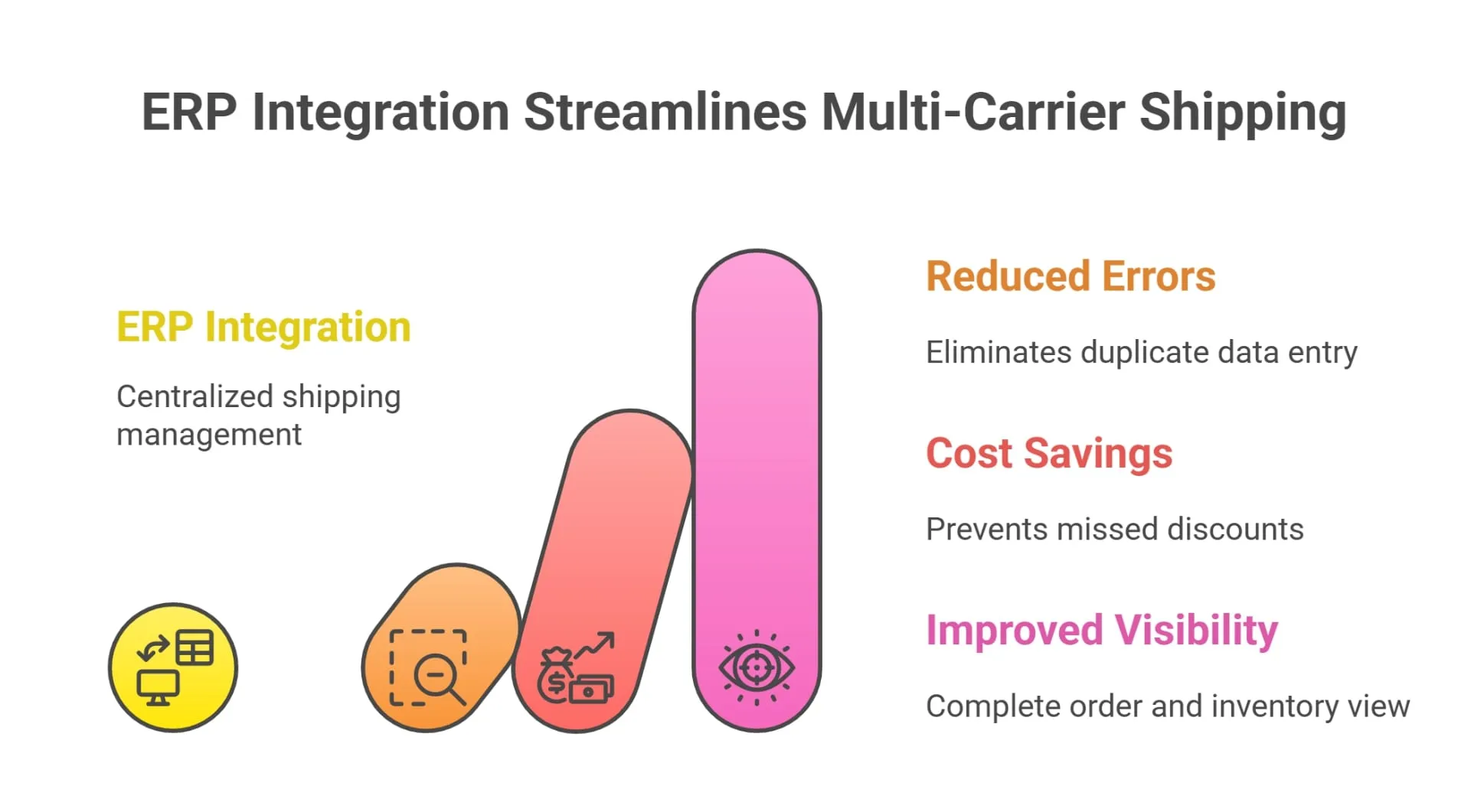
These issues are multiplied when shipping is done not within the ERP: duplicate data entry, missed discounts, wrong service selection, and headaches during reconciliation. Shipping in Business Central will remove the handoff and make shipping decisions that have complete visibility of the orders, inventory, and business rules.
What MetaShip Does
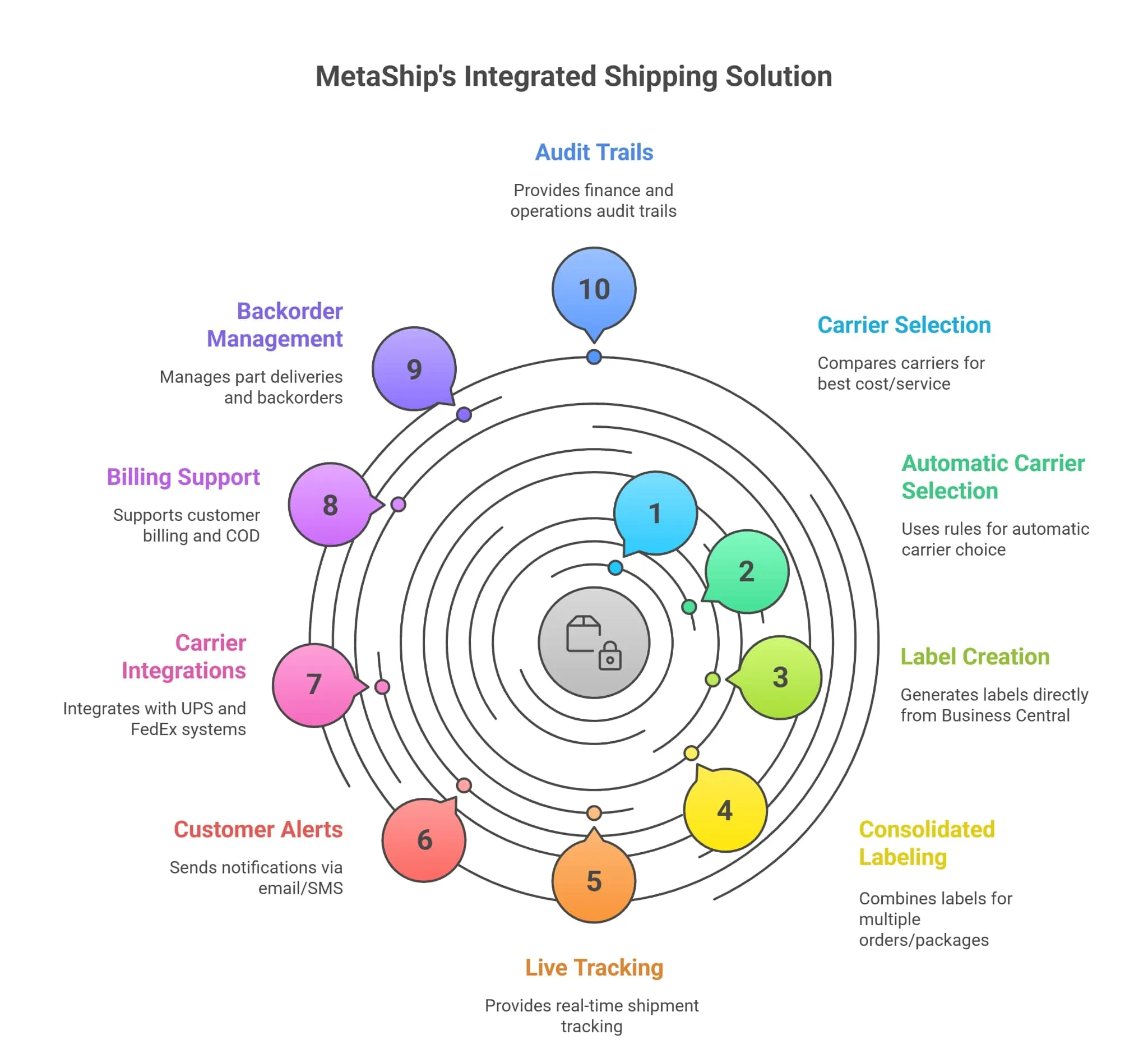
MetaShip multi-carrier shipping integrates shipping into Business Central. Key capabilities include: Compare carriers and services to select the best-cost / best-service.
- Rule-based automatic carrier selection (weight, destination, SLA, cost threshold).
- Label creation & display of major carriers directly out of Business Central.
- Multi-order and multi-package consolidated labeling.
- Live tracking and automatic customer alerts (email/SMS).
- Carrier-specific integrations including UPS WorldShip and FedEx Ship Manager.
- Gather shipping / third-party billing and COD support to allow customers to use their accounts.
- Part deliveries and backorder management became part of fulfillment logic.
- Finance and operations audit trails and shipment reporting within the ERP.
SinceMetaShip multi-carrier shipping is embedded within Business Central, all shipments are linked to the source sales order and inventory transaction, maintaining a single source of truth.
What are the Core Business Benefits?
- Reduced freight expenses through smart rate shopping and consolidation.
- Quick completion because packing, labeling, and manifestation occurs in a single flow.
- Reduced shipping mistakes through automatic address validation, pack validation and forced checks prior to label printing.
- Improved customer experience with correct ETAs and preemptive notifications.
- Less messy accounting since freight expenses, carrier invoices, and shipment information are reconciled to ERP records.
- Scalability in times of peak operations – automated rules minimize manual decisions and rework.
These benefits are not on paper: businesses experience tangible savings in shipping costs and faster ship durations once they switch to an integrated shipping workflow.
How MetaShip Integrates with Business Central?
Business central is the master data source used by MetaShip multi-carrier shipping: sales orders, item dimensions, customer addresses, carrier accounts, and financial posting rules. Upon an order being ready to ship, MetaShip will automatically compare available shipping rules and rate-shops to live carrier rates (or negotiated rates stored in cache), and will offer the best carrier and service. After the selection, the labels are printed, the shipment records are uploaded to Business Central, and the tracking numbers are added to the sales order and customer record.
Technically, MetaShip multi-carrier shipping uses Business Central APIs and connectors to update inventory reservations and shipping statuses in real time. This close integration removes data entry redundancy and makes sure that packing confirmations cause inventory decrements, cost posting, and revenue recognition flows – all in the transactional framework of Business Central. Edge cases that should be included in integration testing include partial shipments, returns, carrier rejections, and split-billing.
Tighten warehouse operations with mobile picking, cycle counts, and lot control for faster, more accurate fulfillment.
Key Features That Make Multi-Carrier Shipping Simple
1. Rule-Based Carrier Selection
Establish business rules – cost limits, speed of delivery requirements, zone exclusions, or carrier-specific customer – and have MetaShip automatically choose the carrier. Regulations discourage on-the-fly carrier decisions that increase prices.
2. Multi-Carrier Rate Shopping
MetaShip is an online service that compares live or contracted rates of various carriers and services to suggest the most appropriate. Dimensional pricing, surcharges, and discounts are all part of rate shopping to make comparisons apples-to-apples.
3. Consolidated Labeling & Multi-Package Support
Print consolidated labels on multi-package orders and create a single manifest where possible. This saves on paperwork and makes carrier pickups easier.
4. Carrier Connectors & External Integrations
MetaShip works with large carriers (such as UPS, FedEx, USPS, Purolator in US/Canada) and can be connected to carrier applications such as UPS WorldShip and FedEx Ship Manager where workflows need them.
5. Collect & Third-Party Billing
Enable customers to bill shipments to their carrier accounts (collect shipping) or do third-party billing – handy with drop-shippers and some B2B applications.
6. Packing Verification & Error Prevention
The system requires pack verification: the items are verified against the pick list and labels are printed. This dramatically cuts down on mis-ships and returns.
7. Real-Time Tracking & Notifications
The events are tracked back into Business Central and may be used to send automated customer notifications through email or SMS to enhance transparency and minimize support requests.
8. Export Documentation & Compliance
In the case of international shipments, MetaShip is able to generate customs documentation, harmonized system (HS) codes, and commercial invoices to facilitate cross-border flows.
Know more: The Best Shipping Software for Business Central – Why MetaShip Stands Out
Real-World Use Cases
Use Case 1: High-Volume E-Commerce Retailer
A retailer operating e-commerce and having thousands of orders per day will have to balance speed and cost between regions. The retailer automated carrier selection by using MetaShip multi-carrier shipping and added consolidation rules to orders that were to the same destination. Labels are printed immediately at packing stations, orders are manifested automatically and tracking numbers are posted to orders and customer accounts.
The outcome: reduced average shipping cost per order because of optimal selection of carriers, reduced packing throughput, and a decreased number of carrier related support tickets. The retailer would add capacity during peak seasons without adding proportionate additional personnel since carriers and services were automatically chosen.
Use Case 2: B2B Distributor with Customer Carrier Accounts
A B2B distributor usually delivers on customer carrier accounts or must reimburse shipping to particular customers. MetaShip also supported collect-shipping and third-party billing processes, which meant that the distributor could utilize the carriers of their choice without having to manually reconcile the billing. The Business Central integration made sure that freight was registered correctly and connected to the correct sales invoices.
This removed untidy Excel-based billbacks, minimized billing conflicts and enhanced cashflow visibility as freight liability was properly recorded. This enhanced customer satisfaction since the carriers and payment terms were automatically aligned with the expectations of the customers.
Use Case 3: Manufacturer Shipping Internationally
A company that was exporting parts to various nations required correct customs documentation and reliable transit time. MetaShip extracted item dimensions, HS codes, and value information out of Business Central and created export paperwork that was compliant. Carrier transit times and customs reliability measures, rather than price, were also part of rate shopping.
Automated documentation and improved carrier selection led to shipments clearing customs quicker, reduced detention costs and improved accuracy of ETA to customers – enhancing overall supplier reliability.
Unify finance, inventory, and logistics on one platform to power smarter shipping and fulfillment.
Start a Business Central consultation
Implementation & Rollout Best Practices
- Clean master data first: Item dimensions, weights, and packaging profiles need to be correct to ensure that rate shopping works properly.
- Map your carrier rules: Determine when to auto-rate-shop vs impose a carrier (e.g., account customers).
- Test one packing station: Check label template, printer connection, and manifesting prior to broad adoption.
- Test edge cases: Partial shipments, COD, collect billing, returns, and carrier rejections.
- Train operators on pack verification: Implement pack checks to minimize mis-shipments.
- Monitor carrier performance: Reporting is used to make adjustments to preferred carriers and negotiate improved rates.
- Integrate with finance: Have carrier costs and accessories posted properly to be audited and analyzed.
- Automate customer interactions: Proactive tracking emails/SMS will reduce the number of support.
- Plan for peak loads: Check API quotas, label generation throughput, and batch manifesting at scale.
- Have rollback and support plans: Have fast reversion paths and vendor support SLAs in cutover.
Measuring Success & ROI
Monitor the following metrics to know the effect of MetaShip:
- Shipping per order cost – reduced by rate shopping and consolidation.
- Order-to-ship time – decreased through label and manifest generation automation.
- Mis-ship and return rates – reduce due to imposed packing verification.
- Carrier chargebacks/claims – fall due to better address validation and packaging regulations.
- Shipping customer support tickets – drop due to proactive notifications and correct tracking.
- Finance reconciliation time – reduced due to shipment records that reconcile to Business Central transactions.
Most organizations pay back their MetaShip investment in a few months through freight savings, labor savings and fewer returns/claims.
Common Challenges and How MetaShip Addresses Them
Data Quality
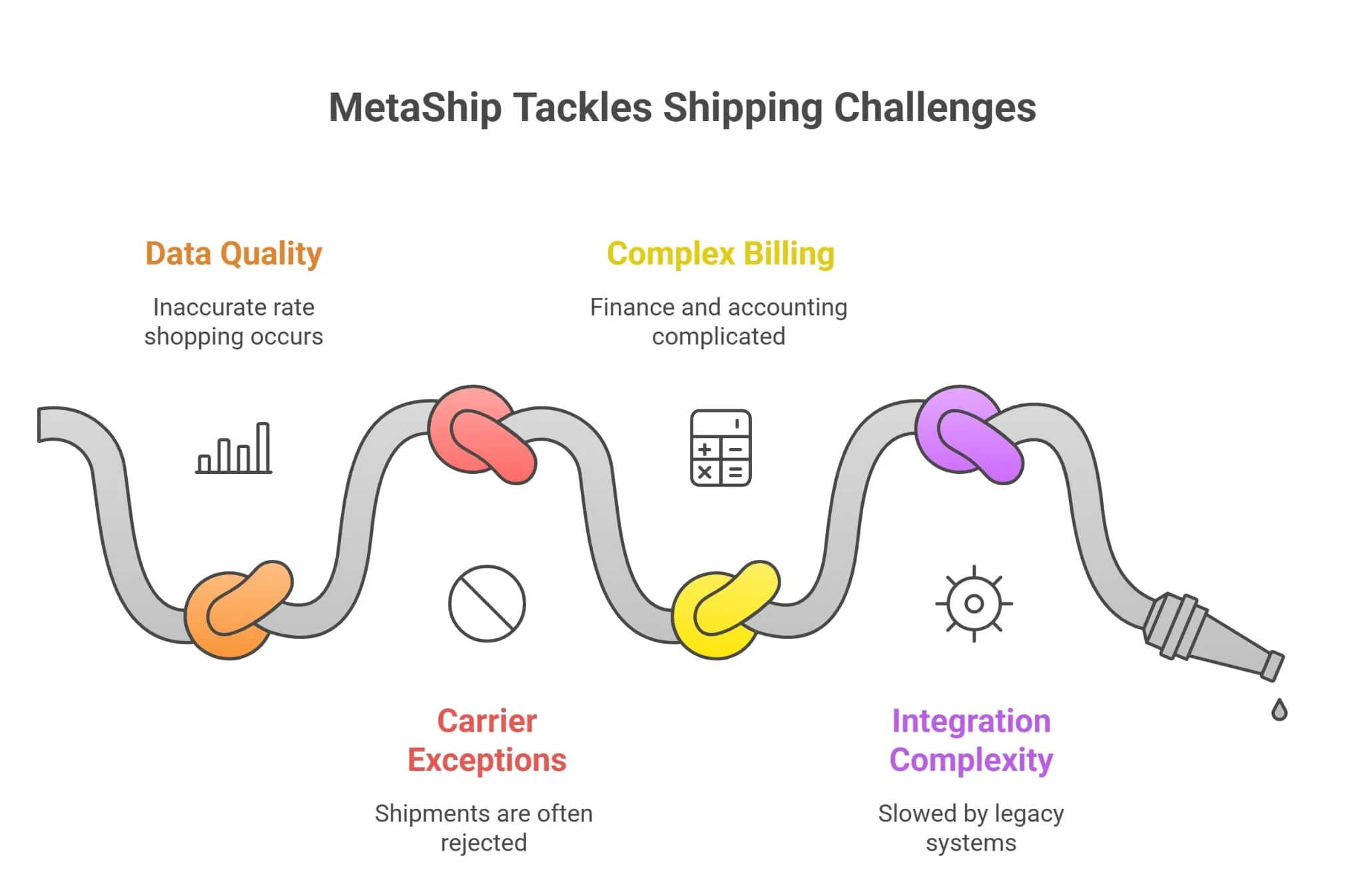
Rate shopping may be inaccurate due to poor item dimensions or bad addresses. MetaShip implements master data validation and integrates Business Central as the single source of truth, which guarantees the use of reliable inputs to compare carriers.
Carrier Exceptions
Shipments (scheduling problems, service suspension) are sometimes rejected by carriers. MetaShip throws exceptions on the spot, reroutes shipments based on pre-established rules, and records the occurrence to be audited and followed up.
Complex Billing Scenarios
Finance can be complicated by collect, third-party billing, and COD. MetaShip records freight costs and billbacks in Business Central based on templates that are configured to ensure consistency and auditing of accounting.
Integration Complexity
Integration can be slowed by legacy systems or carrier APIs that are not well documented. Connectors and carrier integrations tested by MetaShip (such as UPS WorldShip and FedEx Ship Manager workflow) make deployment straightforward, and sandbox testing can help avoid surprises.
Future-proofing Your Shipping Strategy
MetaShip has extensible connectors and rule engines to enable you to add new carriers, marketplaces or regional partners as your business expands. More sophisticated features to look into as you go:
- Smart negotiation carrier performance analytics.
- Optimization of dynamic packaging to minimize dimensional charges.
- Carrier event-driven automated claims handling.
- Carrier hybrid routing and marketplace routing of the best seller-of-record flows.
- Multi-node logistics 3PL / network orchestration APIs.
Since MetaShip multi-carrier shipping is integrated within Business Central, the ability to scale shipping also enhances ERP data and downstream operations such as finance and customer service.
Final Thoughts
If shipping still feels manual, siloed, or error-prone, integrating a purpose-built shipping solution into your ERP is the most effective next step. MetaShip multi-carrier shipping brings carrier intelligence, automation, and ERP-level accountability to your fulfillment flow. The result is tangible: lower freight spend, faster fulfillment, fewer errors, and a better experience for customers and operations alike.
Ready to move from manual shipping workarounds to an integrated, rules-driven shipping engine inside Business Central?