




If you’ve spent any time on a warehouse floor, you know the energy there is unlike anywhere else. Forklifts hum, scanners beep, orders print, and the whole place moves in a kind of orchestrated chaos. It’s loud, busy, and demanding. And here’s the thing: in that hustle, every second matters.
But lately, many warehouse managers are realizing something uncomfortable- their teams are working harder than ever, yet productivity isn’t improving the way it should. The culprit? Outdated systems, manual processes, and a growing mismatch between human effort and technological support.
That’s where automation comes in. Contrary to popular fear, automation doesn’t replace people. It empowers them. It takes the dull, repetitive, error-prone parts of their jobs and hands them to smart software and integrated systems, freeing employees to focus on what humans do best- solving problems, making decisions, and driving value.
Let’s explore how warehouse automation, especially through tools like MetaWMS, is helping companies reimagine workforce productivity. We’ll unpack the challenges, the psychology behind employee engagement, and the hard data proving that automation is not just a technical upgrade but a human one too.
Transform your warehouse into a productivity powerhouse with guided workflows, barcode precision, and real-time visibility.
Schedule a demo of MetaWMS today.
The Productivity Paradox: Working Harder but Not Smarter
Across industries, warehouse labor productivity has been under pressure. Global supply chains are more complex, customer expectations are higher, and the labor market is tighter than ever. Yet many facilities still rely on manual spreadsheets, disconnected systems, and tribal knowledge to keep operations running.
The result? Workers spend too much time searching for products, rechecking orders, correcting mistakes, or waiting for instructions. Managers waste hours chasing updates from different systems. It’s not a lack of effort- it’s a lack of visibility and coordination.
Think of it this way: even the most skilled forklift driver can’t be efficient if the pick list is wrong. Even the fastest packer slows down when barcode labels don’t match what’s in the system. Productivity hits a ceiling not because employees aren’t trying, but because the environment limits their potential.
Automation changes that dynamic. By integrating workflows and eliminating repetitive manual tasks, you shift from people managing systems to systems supporting people. That’s a big mental shift- and it’s where ROI starts to multiply.
The Real Meaning of Workforce Productivity
When most executives hear “productivity,” they think about output per hour- how many orders are processed, how many boxes are packed, how many items are shipped. But true workforce productivity in the modern warehouse goes deeper.
It’s about alignment.
It’s about how seamlessly people, processes, and technology work together.
Productivity is not just speed; it’s precision, predictability, and consistency. And that’s exactly what automation unlocks.
Consider these three dimensions of workforce productivity:
- Operational Efficiency:Reducing time wasted on low-value tasks.
- Cognitive Efficiency:Simplifying decision-making through better data.
- Emotional Efficiency:Creating a less stressful, more rewarding work environment.
When warehouse automation tools like MetaWMS support all three, employees work faster, make fewer mistakes, and feel more confident in their roles. That’s sustainable productivity.
Simplify packing, carrier selection, and delivery tracking while reducing costs.
Discover how MetaShip keeps your shipping team one step ahead.
The Role of Automation in Workforce Empowerment
Automation gets a bad rap. People often equate it with job loss, but in reality, it’s more about job evolution.
In a modern warehouse, automation doesn’t mean robots replacing humans. It means smart systems replacing inefficiency. It means handheld scanners, mobile apps, and integrated dashboards that tell workers exactly what needs to be done- and how to do it best.
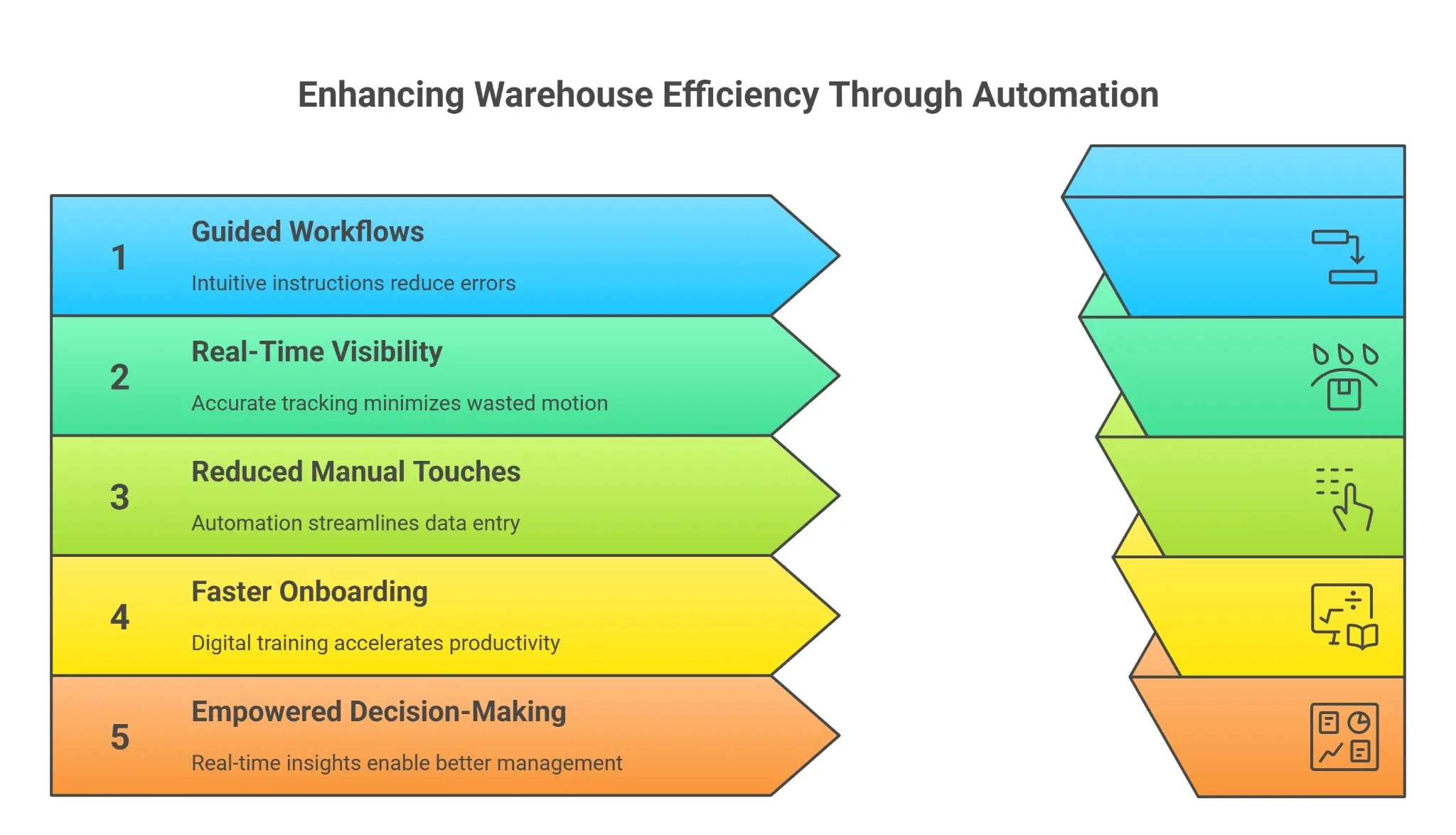
Here’s how automation through MetaWMS empowers warehouse teams:
1. Guided Workflows That Eliminate Guesswork
MetaWMS provides intuitive mobile workflows for tasks like picking, put-away, and inventory counting. Instead of relying on memory or printed lists, workers follow on-screen instructions that guide them through the optimal route and action.
Result: less time spent thinking, more time doing- and far fewer errors.
2. Real-Time Inventory Visibility
Nothing frustrates workers more than searching for items that aren’t where they’re supposed to be. MetaWMS keeps every movement tracked in real time. When something is picked, scanned, or transferred, the system updates immediately.
That visibility reduces wasted motion and cuts down on rework, two of the biggest drains on warehouse productivity.
3. Fewer Interruptions and Manual Touches
Manual data entry is a productivity killer. Scanning and automation remove that bottleneck. Workers can focus on moving goods, not typing into systems. Integration with ERP platforms like Business Central ensures that shipping, receiving, and accounting updates happen automatically in the background.
4. Faster Onboarding and Skill Retention
Training new warehouse employees traditionally takes weeks. With digital workflows and clear system prompts, training time drops dramatically. New hires become productive sooner, and consistent processes reduce dependency on a few “super users.”
5. Empowered Decision-Making
Supervisors can monitor workloads, bottlenecks, and performance through real-time dashboards. Instead of micromanaging, they coach and optimize. Employees can see their own performance metrics too, creating transparency and ownership.
When you give people tools that make them successful, motivation follows.
Why People + Technology Always Outperform Technology Alone
Here’s a truth many leaders overlook: technology by itself doesn’t create productivity. It’s the combination of human capability and digital tools that does.
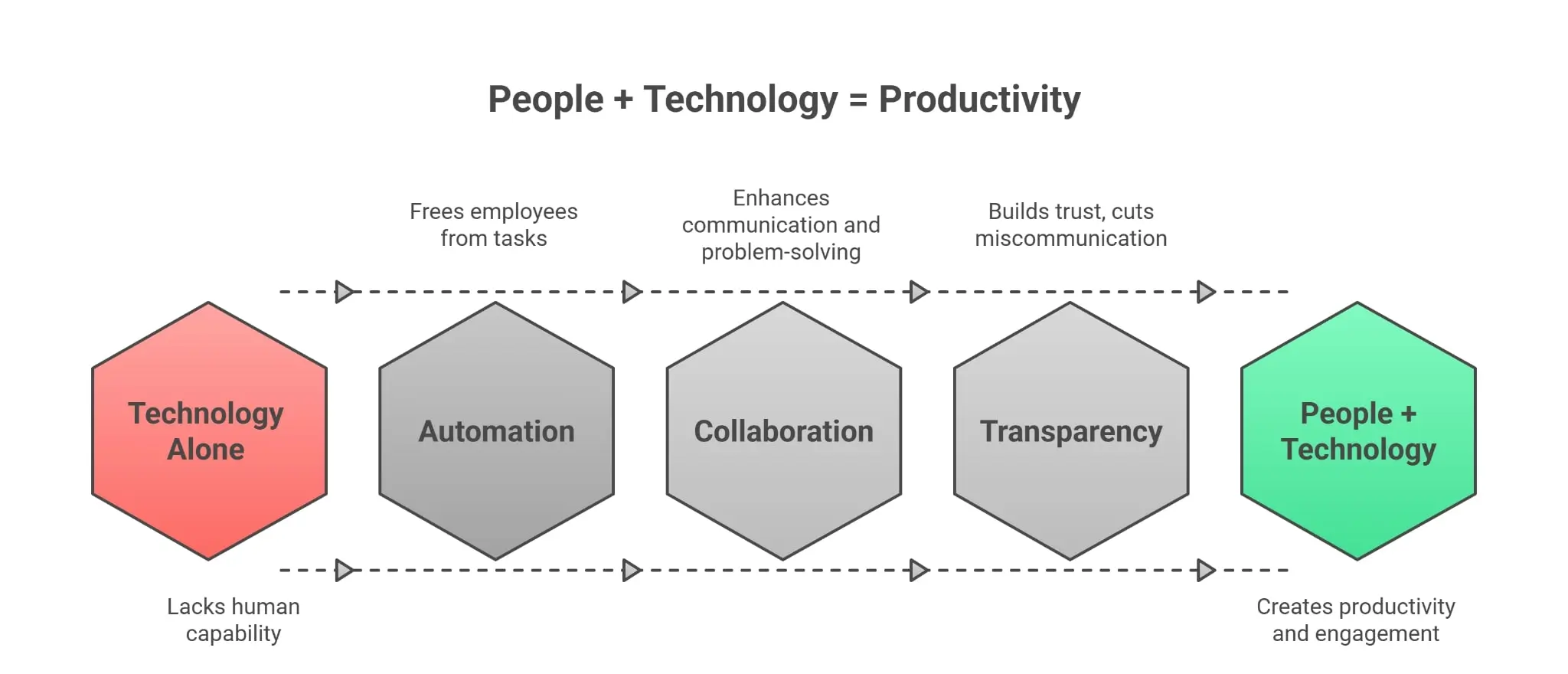
Automation frees employees from repetitive tasks, but it also enhances their ability to collaborate, communicate, and problem-solve. When employees trust that the system works, they take more initiative. They’re more confident, more proactive, and more engaged.
MetaWMS, for instance, allows real-time collaboration across departments. Warehouse staff, supervisors, and procurement teams share the same source of truth. That transparency builds trust and cuts down on miscommunication.
And let’s be honest- when employees spend less time chasing missing inventory or redoing orders, their stress levels drop. A calmer, more focused workforce is a more productive one.
Unify your warehouse, shipping, and finance operations with
Microsoft Dynamics 365 Business Central for complete control and insight.
Data Doesn’t Just Improve Operations. It Improves People.
Every scan, every order, every movement in MetaWMS creates a data point. When analyzed properly, this data reveals powerful insights- not just about goods, but about how people work.
Managers can identify patterns: who’s excelling at picking accuracy, which shifts outperform others, or which areas need retraining. The goal isn’t to micromanage but to improve coaching and recognize excellence.
Data turns subjective opinions into objective understanding. It also helps reward top performers, making warehouse work more merit-based and motivating.
For example, if analytics show that automation has cut walking time by 30% and increased picks per hour by 20%, you can link those metrics to tangible incentives. Workers see the impact of their efforts in real time- and that’s deeply motivating.
Breaking the Fear Barrier Around Automation
Change is always hard. Whenever automation enters the conversation, there’s a natural fear of replacement. The key to overcoming that fear is communication.
Workers need to see automation not as a threat, but as an ally. The best way to do that? Involve them early.
When employees participate in implementation- helping test mobile workflows, refining scanning processes, or suggesting better layouts- they take ownership. They feel part of the improvement, not victims of it.
Leadership should emphasize that automation’s purpose is to remove friction, not reduce headcount. The narrative matters: “We’re using technology to help you do your job better, faster, and safer.”
Real-World Productivity Gains from Automation
Numbers speak louder than promises. Let’s look at real, measurable impacts companies experience after implementing warehouse automation.
- Picking accuracy increases up to 99.9%.Barcode-driven workflows nearly eliminate wrong-item picks.
- Order processing time drops by 30–50%.Real-time updates mean less downtime and faster shipping.
- Training time decreases by 60%.Clear mobile interfaces make it easier for new hires to learn quickly.
- Warehouse throughput improves by 25–40%.Better routing and task sequencing maximize every labor hour.
- Employee turnover reduces significantly.Less frustration and clearer expectations create a more positive work culture.
These aren’t just efficiency gains- they’re financial wins. Fewer mistakes, faster turnaround, and lower churn all contribute directly to profitability.
The Connection Between Productivity and Safety
Here’s something often overlooked: automation doesn’t just make workers faster; it makes them safer.
When workflows are standardized and tasks are digitally guided, there’s less confusion on the floor. Employees don’t have to rush blindly to meet targets. They follow logical sequences that minimize accidents.
MetaWMS can even integrate with IoT sensors to track forklift movement, zone occupancy, and temperature levels for sensitive goods. By combining data and automation, safety compliance becomes a built-in feature, not an afterthought.
A safer workplace means fewer disruptions, fewer claims, and higher morale- all part of long-term workforce productivity.
Beyond the Warehouse: Connecting Automation with Shipping
The magic really happens when the warehouse doesn’t operate in isolation. That’s where MetaShip comes in.
Once orders are picked, MetaShip automates the next phase- packing, labeling, carrier selection, and tracking. The integration between MetaWMS and MetaShip eliminates another layer of manual coordination.
When a worker finishes picking an order, the shipping label is ready instantly. The system automatically selects the most cost-effective carrier based on delivery deadlines. Tracking numbers sync back into the ERP without anyone touching a keyboard.
From the worker’s perspective, it feels seamless. No waiting for approvals. No jumping between systems. Just flow.
And that smooth flow? That’s the essence of productivity.
How Automation Enhances Employee Morale
Let’s be real: no one wakes up excited to count inventory manually or reprint mislabeled boxes. Those repetitive tasks drain morale.
Automation flips the script. It gives workers a sense of progress and mastery. They see data moving in real time, tasks being completed efficiently, and systems actually helping them- not slowing them down.
Employees who use modern warehouse workforce productivity tools often describe their jobs as less stressful and more professional. There’s pride in working with advanced systems. It signals that the company values innovation and employee well-being.
And when people feel valued, productivity follows naturally.
Measuring Human-Centric ROI
When calculating ROI for automation, don’t stop at labor cost savings. Look at qualitative gains:
- Reduced turnover:Lower hiring and training costs.
- Fewer accidents:Lower insurance and downtime costs.
- Higher employee satisfaction:Improved retention and productivity.
- Enhanced brand reputation:Customers trust efficient, reliable partners.
These intangible benefits often exceed the direct financial gains. Happy, well-equipped teams simply perform better.
The Future of Warehouse Work
Automation is not the future. It’s the present. But the future of warehouse work will go even further- think AI-driven demand forecasting, voice-guided picking, and self-learning warehouse layouts.
The difference is, humans will remain at the center of it all. Automation will continue to handle the grunt work, while people focus on oversight, quality control, and creative problem-solving.
As the technology evolves, tools like MetaWMS will integrate even more tightly with analytics and IoT platforms. Workers will have real-time insights on their handhelds, supervisors will manage predictive dashboards, and the entire operation will function like a living, learning organism.
The line between digital and physical will blur- but the role of human intelligence will only become more important.
Getting Started with Workforce Empowerment
If you’re ready to bring automation to your warehouse but don’t know where to start, here’s a practical roadmap:
- Map your workflows.Identify repetitive, manual steps that cause frustration or delay.
- Start small.Pilot MetaWMS in one process area (like picking or receiving) to prove ROI quickly.
- Involve your team.Ask operators for feedback on what slows them down- then let automation fix it.
- Integrate with shipping.Add MetaShip once your warehouse processes are stabilized to create a full fulfillment flow.
- Track progress.Use analytics to measure labor hours saved, error rates reduced, and employee feedback.
- Scale and optimize.Expand to other locations or business units once you’ve established success.
Remember, automation is a journey. The earlier you start, the sooner you’ll see the compound effects on performance and morale.
Final Thoughts
Warehouse automation is often seen as a technology project, but it’s really a people project. The real ROI isn’t just measured in faster picking or reduced costs- it’s measured in smiles, confidence, and pride on the warehouse floor.
When workers are supported by smart systems like MetaWMS and MetaShip, they perform better, stay longer, and contribute more. They stop being just operators and become empowered professionals.
That’s the heart of modern productivity- not replacing people, but elevating them.