




Adopting top warehouse automation trends is the simplest key strategy to address warehousing obstacles in 2026.
How many of you agreed with this fact?
As the ecommerce and retail sector continues to grow, warehouse operations are becoming increasingly complex. Running a warehouse in 2026 will often feel like spinning plates without the right warehousing strategy in place.
With rising labor costs, constant errors, and shrinking margins, it isn’t very easy to manage operations correctly.
For many operations, labor eats up 65-70% of total costs, whereas warehouse managers say that labor shortage is their biggest headache.
In addition to that, manual picking and walking around take up too much time. This is where warehouse automation can reduce the stress of managing labor by 40%.
As we are moving into 2026, warehouse automation isn’t just transforming- it’s accelerating the process. But what actually drives the industry?
From inbound case handling to outbound order fulfillment, here are the top warehouse automation trends in 2026 to watch out for. These trends are redefining modern warehousing and distribution needs. All you need to understand how each of the top warehouse automation trends is preparing the leading organization for the next era of supply chain innovation.
Let’s get into emerging warehouse automation trends that are reshaping the warehousing needs in 2026.
2026 Warehouse Automation Trends: From AI, Robotics to Full Automation
As 2026 is just around the corner, many of you are preparing to explore the innovations and strategic shifts that will define material handling and warehousing. The further path of innovation may be marked by challenges, but companies ready to automate warehousing and inventory management will leverage promised growth and excellent efficiency.
Whether it be harnessing AI capabilities to automate the process or a strategic plan for adopting this change, here we have covered 25+ warehouse automation trends for 2026. Each warehouse automation trend is grouped into major categories to help you navigate these changes with purpose.
1. Warehouse Automation Trend: AI is the Force Behind Demand Forecasting
Did you know that AI can help achieve 99% inventory accuracy? Wondering how it happens?
Most warehouses struggle with unexpected demand surges and stockouts due to poor visibility. This is where manual inventory forecasting leads to either overstocking, wasting warehouse space and capital, or making it out-of-stock during peak time.
This is why 45% of companies have incorporated machine learning into their demand forecasting, and nearly 50% use AI in multiple functions like inventory and supply chain.
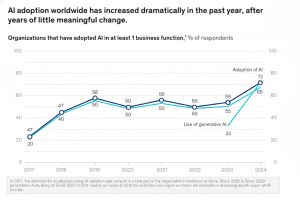
How AI-driven automated warehouse solution help you practically?
- AI analyzes the sales channels, seasonal demands, and external signals to forecast demand in real-time.
- After detailed analysis, it automatically sends alerts to the managers when stock is about to run out of stock.
Result- Implementing AI-driven automation in managing inventory can help reduce 30% cost and bring a 40% boost in overall productivity by simply managing it mindfully.
Read More: What Are Serial and Batch Numbers and Why Do They Matter in The Warehouse?
2. Warehouse Automation Trend: Hyper-Intelligent Picking is Going Beyond Just Speed
Warehouses often struggle with accuracy issues that cause the biggest ripple effect in returns, rework, and unhappy customers. Every mispick is a cost drainer.
The next-gen systems combine computer vision, audit-trail validation, and real-time correction to ensure precision before the item even leaves the bin.
Major benefits of automated warehouse picking include:
- Error-proof workflows that lead to faster pickups
- Reduced rework and ensured frictionless product returns
- Winning customer trust and SLA compliance
Results: Warehouses implementing AI-powered picking validation notice a 72% drop in mispick-related returns within months.
3. Warehouse Automation Trend: Software Outpowering Hardware
If your warehouse is still relying on physical automation, then be ready to deal with rigid workflows. Once layouts or customer demand change, fixed hardware starts troubling the system. It leads to bottlenecks and sunk investment.
Shifting hardware with cloud-based warehouse automation software is now automating the entire workflow. From routing decisions to task allocation, with next-gen inventory management software, you can manage everything without requiring new machines.
What does it bring to the table?
- It offers instant workflow reconfiguration
- Faster response to seasonal or SKU spikes
- Granular control over performance metrics
Results: Software-driven automation shrinks deployment time from months to weeks and making warehouse transformation iterative.
4. Warehouse Automation Trend: Robotic-as-a-Service Ensuring Automation Without Heavy Commitment
In 2026, the biggest challenge that you want to get rid of is the traditional automation that demands multi-year capital investments. Moreover, long procurement cycles and complex maintenance make the entire adoption challenging.
This is where adopting RaaS can help warehouses scale the cloud storage. Just plug in, pay monthly, scale up or down based on demand.
So what changes does it bring to the system?
- Robots become operational expenses, not assets.
- Maintenance, upgrades, and software work in perfect coordination.
- Adoption becomes practically friendly
Results: RaaS-driven facilities deploy automation 3-5X faster, especially for high-mix SKU environments, and make automation accessible even for the lower-budget businesses.
5. Warehouse Automation Trend: Eliminate Guesswork From Operations With Digital Twins
When there is no visibility into real-time insights, warehouse teams often make decisions based on assumptions. Whether it be changing the layout of shelves or introducing new SKUs, there is always guesswork included. This is where installing an automated warehouse system can easily replace the hassle of weeks.
Now, how do Digital Twins work?
It helps fix that problem by simulating workflows before execution. They model labor movements, robotic paths, and storage constraints, which ultimately reduces the risk of predictions.
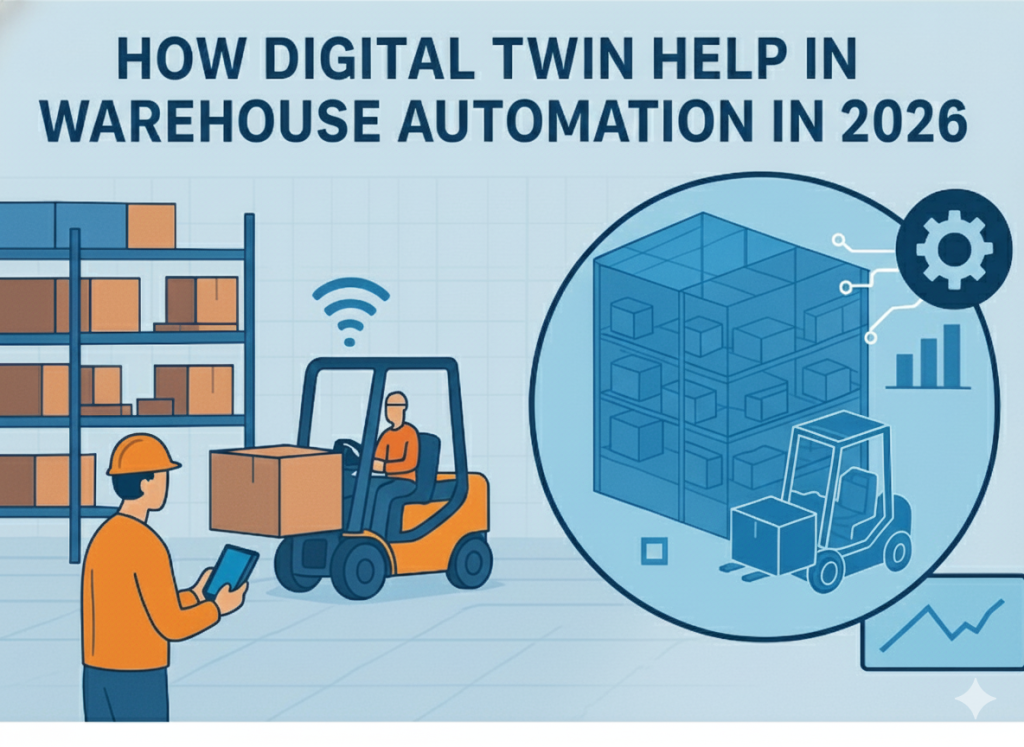
How do Digital Twins Work?
- To avoid guesswork, it helps to test ideas without halting live operations
- Predict bottlenecks before they occur
- Enables you to deeply optimize layout and routing based on real behavior
Result: Replacing the manual workflows with these warehouse automation trends in 2026 can help improve space utilization by 15–30%. It also eliminates the risk of costly trial-and-error.
6. Warehouse Automation Trend: Human and Machine Collaboration Can Achieve Full Automation
Full automation sounds ideal, but staffing gaps, seasonal fluctuations, and SKU complexity often require human judgment. Instead of replacing labor, automation now supports it.
Wearables, cobots, and assistive AI reduce stress and enhance decision-making accuracy.
How does it add value to your warehouse?
- Lower strain-based injuries
- Ensuring faster onboarding for seasonal workers
- Offering stable performance even with workforce turnover
Result: Companies using this collaborative approach in 2026 for warehouse automation can achieve a 32% higher retention rate.
7. Warehouse Automation Trend: Autonomous Mobile Robots Owning Internal Transport
Managing, optimizing, or arranging warehouse layouts or inventories by walking still consumes up to 50% of a picker’s shift. This leads to wasted time and effort.
Businesses choosing to implement AMRs can eliminate unnecessary travel by transporting totes, pallets, and picked items automatically through smart robots.
How it improve warehouse operations?
- Minimizes walking distance
- Offering better workflow continuity
- No reliance on manual push carts or forklifts
Result: Using Autonomous mobile robots for managing warehouse inventory can ensure faster throughput, especially in high-SKU environments.
8. Warehouse Automation Trend: Vision Systems Becoming the New Quality Gate
Manual scanning and barcode checks are slow and error-prone, especially when SKUs are mislabeled on the products or packages are damaged.
Vision-powered validation works instantly. It checks dimensions, serials, labels, and packaging conditions while ensuring complete quality control of the product.
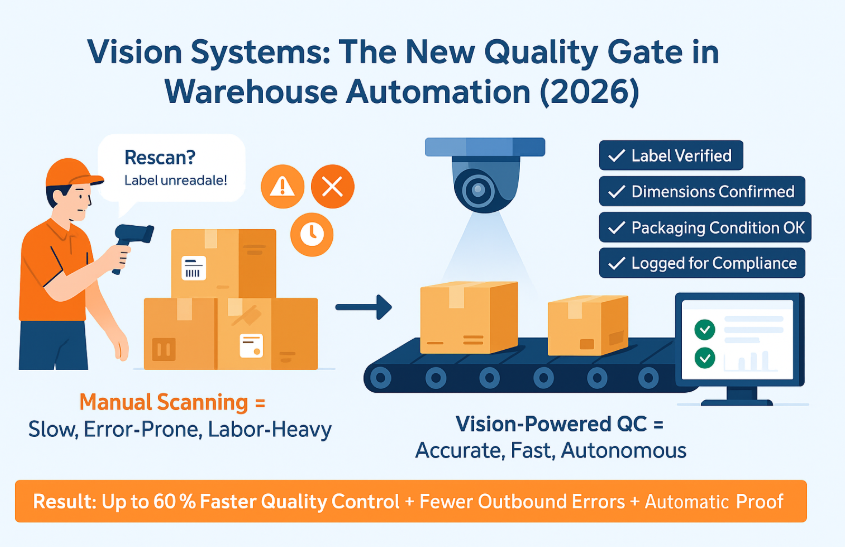
Here’s why it counted as the top warehouse automation trend in 2026:
- Fewer outbound errors
- Automated compliance documentation
- Faster handoffs between workflow stages
Results: Vision-assisted packing processes minimize quality check time by simply automating the label verification process.
9. Warehouse Automation Trend: Micro-Fulfillment Inside Existing Space
Always dealing with a lack of space in the warehouse? Well, urban demand and shorter delivery windows expose a major pain of running out of space.
Instead of deciding to invest in larger warehouses, it’s time to think of micro-fulfillment systems. It helps compress SKU storage into high-density automated models that help accommodate more SKUs in less space.
Why does it matter?
- More SKUs stored in less space
- Faster access to stock and the ability to retrieve it
- Lower outbound cycle time
Result: Automated storage warehouse solutions can help manage the inventory in a better way. In fact, with rightly planned SKUs, the storage capability can be increased by 200-300%.
10. Warehouse Automation Trend: Predictive Maintenance Replacing Firefighting
Did you know unplanned equipment failure in warehouse and industrial settings can cost approximately $10,000 per hour for a large warehouse?
Unexpected equipment downtime can spoil the entire distribution schedule and SLA commitments. But it can be controlled by implementing AI-driven predictive maintenance into warehouse automation can help predict wear and failure of equipment before it breaks.
Impact:
- Major reduction in unplanned shutdowns
- Longer machine lifespan and enhanced productivity
- Controlled maintenance scheduling
Result: By using AI and IoT sensors to determine the real-time condition of the equipment, warehouses can make a condition-based maintenance strategy. Unplanned outages and breakdowns can be reduced by 70% and 30-50% reduction, in overall machine downtime.
11. Warehouse Automation Trend: Stocktaking and Cycle Counting to Get Real-Time Inventory Visibility
Inaccurate records with manual stock count can lead to stockouts, wasted space, and lost sales. In addition, it is also rigid to scale.
So instead of just delaying the stock counting or keeping it an annual counting process, you can automate the process using RFID, drone audits, and AI-powered reconciliation to maintain inventory accuracy continuously.
Outcome:
- No more manual stock counts
- Livestock tracking becomes possible with barcode scanning
- Faster fulfillment decisions with real-time insights
Result: Businesses using an AI-driven stock counting process can increase visibility to stock count and enable you to reach 99.9% accuracy.
12. Warehouse Automation Trend: Multi-Agent Orchestration Over Single System Control
Are you still relying on the old approach- one system, one robot? If yes, then it’s time to get ready for the new era where multiple robots, equipment, and software operate as one synchronized ecosystem to make everything work faster and smarter.
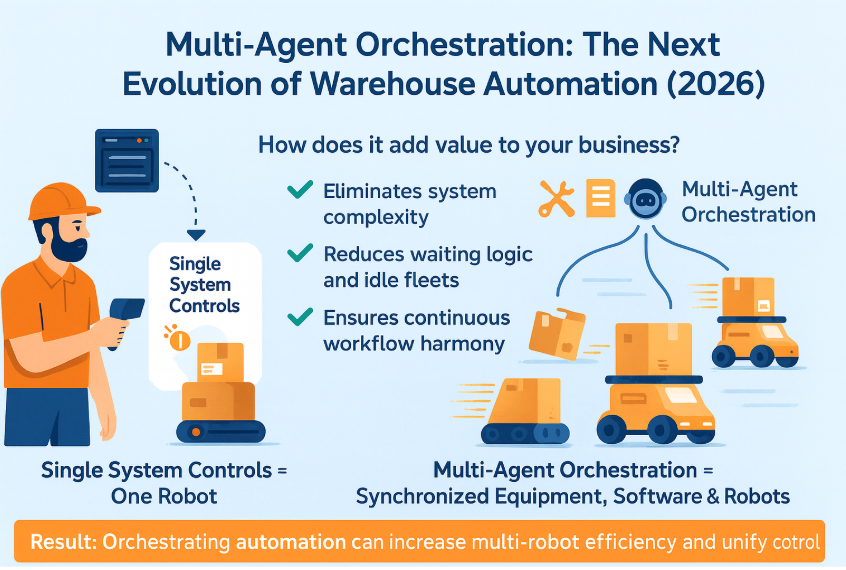
How does it add value to your business?
- Eliminates system complexity
- Reduces waiting logic and idle fleets
- Ensures continuous workflow harmony
Result: Orchestrated automation can help increase multi-robot efficiency and allow you to manage everything with a unified platform without any need to switch between platforms.
13. Warehouse Automation Trend: Adopting Zero-Touch Returns Processing
Processing and handling product returns with manual procedures drains time, space, and labor costs. It not only leads to dissatisfaction among customers but also increases complexity in inventory management.
This is where one such warehouse automation trend in 2026 is adopting zero-touch returns processing. It helps automate returns evaluation, routing, and refurbishment, and eliminates manual sorting chaos.
How does it benefit your warehouse?
- Faster restocking with smoother returns
- Reduced handling frustration
- Better reverse-logistics accuracy
- No cost drainage over multiple return handling
- Result: Zero-touch returns reduce processing time and allow you to manage inventory records automatically.
14. Warehouse Automation Trend: Leveraging Robotics in Cold Storage
Cold environments amplify physical strain and error rates, which makes workers stay longer on their feet.
Automation brings consistency and safety to frozen and refrigerated inventory management.
Value unlocked:
- Stable output regardless of temperature
- Lower labor dependency
- Higher SKU accessibility
Result: Automated cold storage improves worker safety metrics by over 80% by simply identifying the right product at the right time. It all needs a quick scan, and robots automatically access the cold products.
15. Warehouse Automation Trend: Autonomous Forklifts Replacing Manual Pallet Handling
Forklift accidents are one of the most frequent safety concerns that warehouses are dealing with, even in 2025.
Shifting to autonomous forklifts can reduce collisions using obstacle recognition and precision routing.
How can it practically impact on warehouse?
- Enables 24/7 pallet movement without breaks or shift dependency
- Improves consistency during peak order volume
- Eliminates operator error in pallet stacking and retrieval
Result: Organizations deploying autonomous forklifts report 70% safer working environments and fewer safety incidents. There will be faster pallet transfer times and lower pallet damage.
Final Words: The Next Era of Warehousing Isn’t Coming – It’s Already Started
Ready to transform your warehouse operations in 2026? If yes, then the above top warehouse automation trends for 2026 will help you improve your warehouse management process. The ultimate goal of listing these trends is to unify your warehouse system and eliminate the hassle of switching between various platforms to manage various inventory management processes.
As labor shortages keep rising, consumers’ expectations tighten, and order volumes keep fluctuating. Using traditional warehouse management so methods leads to failure. The real shift in 2026 isn’t about adding more machines- it’s about building intelligent, scalable, and interoperable warehouse systems that can think, respond, and optimize in real time.
From AI-powered picking to predictive maintenance, there are various top warehouse automation trends in 2026 that are roaring and automating warehouse operations.
Common FAQs
What is Warehouse Automation?
Warehouse automation refers to using technology, robotics, and AI to perform repetitive tasks like picking, packing, lifting, storing, and moving inventory with minimal manual effort. The goal is to reduce labor costs, speed up fulfillment, and improve safety.
What are the core benefits of warehouse automation?
The key benefits of warehouse automation may include:
- Lower labor and operational costs
- Higher picking accuracy and reduced errors
- Improved worker safety
- Faster order fulfillment
- Ensure easy scalability during peak seasons
Is warehouse automation expensive to implement?
The cost of adopting warehouse automation actually depends upon your needs. With models like RaaS and cloud-based warehouse automation software, businesses can automate operations without investing in a higher upfront cost.
What types of warehouse automation systems exist?
The most common types of warehouse automation systems are:
- Automated storage warehouse systems (AS/RS)
- Automated warehouse picking solutions
- AMRs and autonomous forklifts
- Other warehouse automation software systems like WMS, WES and orchestration platforms.
What is the future of warehouse automation?
The future of warehouse automation is more inclined towards adopting scalable software-driven products and plug-and-scale systems. This means warehouses can update, expand, or modify automation based on changing business needs.
How do I know whether my warehouse is ready for automation?
To determine whether your warehouse needs automation, you need to check if you are experiencing:
- Delays in pickups and errors in data
- Constantly rising labor costs
- Struggling to scale during peak season
- inventory discrepancies or stock visibility issues
If any of these exist, then you need to adopt one of the top warehouse automation trends in 2026 to stay competitive and productive.
