



Warehouse inventory system—do you really need the best version of WMS in 2026?
Not sure? Think of this…
A new order comes in, your customer is expecting the fast delivery on the committed date and your team dives into the warehouse to fulfill it.
But this is where reality hit so hard- instead of smooth picking, the search becomes a scavenger hunt.
Team starts with this: “Where’s this SKU?” “Is that pallet still available?” “Wait, did we over‑ship last week?”
If this sounds familiar, your warehouse inventory system is probably working against you instead of for you.
You’re not alone! But as your business grows, that “good enough” way of running things turns into stock‑outs, write‑offs, and frustrated customers.
The solution usually starts with one phrase: Warehouse Inventory System.
At MetaOption, we see this as the backbone of any modern warehouse. It’s not just a piece of software; it’s a warehouse inventory system that tracks what you have, where it is, and how it moves- and above all, gives you real‑time visibility instead of guesswork.
Gain real-time inventory visibility and eliminate warehouse guesswork with MetaWMS.
Schedule a DemoWhen combined with strong inventory tracking software and stock management, you will experience:
- Shrinking scenarios of stock‑outs and overstocking
- Improve inventory accuracy
- Speed up order fulfillment
- Connect your warehouse execution with your financial and planning systems (like Dynamics 365 Business Central)
In this blog we will provide you complete guide about what a warehouse inventory system really is, why it matters, what features to look for, and how tools like barcode scanning, RFID inventory, and cycle counting will turn your warehouse operations into intelligent workflow.
What is a Warehouse Inventory System?
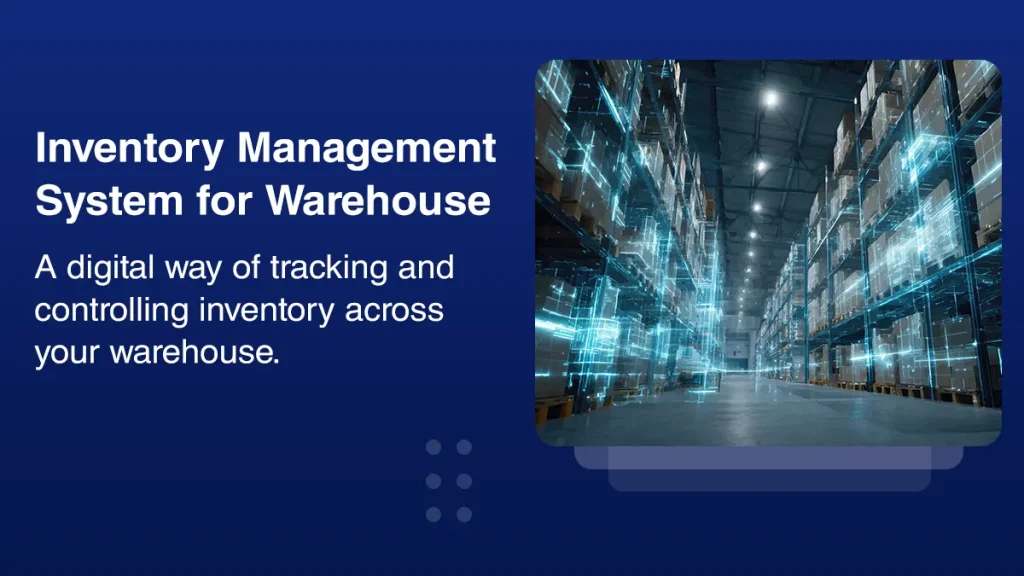
A warehouse inventory system is a digital way of tracking and controlling inventory across your warehouse. At MetaOption, we design this system to sit at the intersection of warehouse execution and business intelligence.
A typical warehouse inventory system includes below features:
- A digital layout of your warehouse, including bins, racks, and zones
- Real‑time tracking of stock levels by SKU and location
- Tools to manage the pick, pack, and ship of inventory
- Smart insights that help you plan and optimize inventory
Think of it as a controlling layer of everything that enables you to handle the movement of inventory.
But what so different about MetaWMS? This system is powered by inventory tracking software that enables you:
- Determine what you have in stock right now
- Know exactly where each item is stored
- Track every movement right from when they enter and going out
- Plan replenishments and reorders to avoid inventory distortion
Whether you operate a small distributor center or a multi‑warehouse network, the high level of visibility is always critical. And it’s exactly what MetaOption’s MetaWMS is built to deliver.
Types of Warehouse Inventory Systems
| System Type | Best For | Key Characteristic |
|---|---|---|
| Standalone WMS | Complex, high-SKU warehouse operations | Purpose-built for warehouse workflow management |
| ERP-Integrated IMS | Unified financial & operational visibility | Single platform covering finance, procurement & inventory |
| Cloud-Based SaaS | Mid-market and distributed operations | Rapid deployment, auto-updates, remote access |
| Industry-Specific Systems | Food & beverage, pharma, automotive, 3PL | Sector-specific compliance and workflows built-in |
Why WIS Matters— The Real Cost of Getting It Wrong
Let’s start with a number that should stop any executive in their tracks: $1.77 trillion. That is the estimated global cost of inventory distortion, which combines the impact of excess stock and stockouts.
If you are still not convinced, then let these stats and facts give you a clear picture…
Key Statistics on Inventory Errors and Losses (2024–2026)
| 83% Is the average inventory accuracy across most organizations, which means 1 in 6 records that are wrong. CAPS Research / NetSuite, 2024 | 11% Average annual revenue lost due to inventory distortion (stockouts + overstocking) Firework, 2024 | 43% Of businesses don’t even track inventory and still use outdated manual systems/ Spreadsheets Myos / Firework |
| 1.4% Of annual warehouse revenue lost to shrinkage alone GoRamp, 2026 | 35% Improvement can be achieved in stock accuracy with real-time tracking and ditching through periodic counting Opensend / AnchorGroup | $10.5B Projected WMS market size by 2030, growing at 16% CAGR from 2022 Myos / ProcurementTactics |
| DATA | 56% of retail industry executives agree with the fact that they are working with outdated or inaccurate data. This directly undermines purchasing decisions, demand forecasting, and customer commitments. (Source: IBM Research) |
Understanding the Urgent Needs of Warehouse Inventory Systems in 2026
Most warehouses start with basic where inventory is small and management. In that scenario, spreadsheets or manual stock counts really work. You can:
- Manage the number of SKUs on sheets
- Access a simple layout of inventory for decision-making
- Work with a team using strong memory and basic tools
But as volumes, locations, and SKUs increase, that once “good enough” system started cracking. You start to see:
- Items are suddenly “disappearing” between receiving and shipping
- Stock‑outs, despite the sheets saying you have stock
- Confusing reports and mismatched numbers
That’s where inventory tracking software from MetaOption, such as MetaWMS, comes as a game-changer.
It’s a smartly designed warehouse inventory management software built on robust inventory tracking basics, which go beyond determining what you have in stock. It gives you strength and functionalities to manage it well across all locations intelligently.
Good stock management, powered by MetaOption, like MetaWMS, can:
- Prevent overstocking, which ties up working capital
- Reduce obsolescence and expired stock
- Improve on‑time, accurate delivery rates
- Generate cleaner, more reliable reports based on real-stats for decision‑making
In short, your warehouse starts working in a well-structured manner instead of a revenue leakage engine.
So when choosing the warehouse inventory system, what features do you need to evaluate…?
Key Features of a Modern Warehouse Inventory System
Not all systems are built equal. For a C-suite leader evaluating options, the feature checklist below reflects what separates a best-in-class WMS system from an expensive spreadsheet upgrade.
Each capability directly drives cost savings and customer service gains. So here are the features that you need to pay attention to while adopting the Warehouse inventory system…
- Real-Time Stock Updates: Live dashboards showing real-time movement of stock levels across all warehouse zones and distribution centres. All the data is instantly updated as any transactions occur, instead of waiting for the end-of-day batch processes.
- Barcode Scanning Integration: Integrated barcode scanning for receiving, putaway, picking, packing, and shipping minimizes the manual data entry errors and efforts. It accelerates the warehouse process by 5X.
- RFID Inventory Tracking: Using RFID is ideal for bulk scanning, automated receiving, and real-time location tracking. With this, the inventory tracking accuracy rates can jump from 65% to 99%+.
- Cycle Counting Module: It is a structured program continuously used for auditing the rolling inventory and eliminating disruptive full-count shutdowns while maintaining high inventory accuracy.
- ERP & System Integration: This helps connect the ERP and entire system with multiple systems, including e-commerce systems, accounting software, and logistics providers to deliver a one consolidated view.
- AI-Driven Demand Forecasting: Predictive tools will be given to analyze historical data to predict future demand, reducing excess inventory by 10-15% and preventing costly stockouts.
- Bin & Location Management: Granular warehouse mapping down to zone, aisle, rack, shelf, and bin, and enabling directed putaway, optimized pick paths, and faster cycle counts.
| ROI | Automated inventory tools and functionalities increase operational efficiency by up to 50%, minimize manual efforts and human errors. (Source: Firework, 2024) |
Crucial Matrix To Prioritize Features
| Feature | Priority Level | Impact Area | Typical ROI Timeframe |
|---|---|---|---|
| Real-time inventory tracking | Must-Have | Accuracy, visibility | 30-60 days |
| Barcode scanning integration | Must-Have | Speed, error reduction | 30-90 days |
| Cycle counting module | Must-Have | Improves data accuracy, audit compliance | 60-120 days |
| ERP integration | Must-Have | Data consolidation and unified inventory reporting | 60-180 days |
| RFID Scanning | Top Priority | Ensuring Speed, automated inventory scanning | 12-24 months |
| Demand forecasting / AI | High Priority | Inventory distortion sost reduction, data-based future demand forecasting | 3-6 months |
| Multi-location management | High Priority | Important for scalability and seamless growth | Varies |
Barcode Scanning Vs RFID Inventory: A Technology Comparison For Accuracy and Speed
Two technologies dominate the warehouse floor when it comes to tracking items: barcode scanning and RFID inventory systems. Both are powerful tools, and MetaOption’s MetaWMS supports both, depending on your warehouse needs.
Let’s get into the details of each technology to understand its strengths and limitations…
Barcode Scanning: The Deep Integration and Automation
| Advantage | Limitation |
|---|---|
| Used in over 70% of global warehouses and is widely understood | Requires line-of-sight, therefore one scan per item, per person, which may impact the speed |
| Low cost to implement and minimal upfront hardware investment | Labor-intensive at scale; human fatigue leads to scan errors |
| High accuracy in controlled environments with intact labels | Damaged or missing labels need to be created manually |
| Virtually compatible with all WMS and ERP platforms | Cycle counts are slow and disruptive for large facilities, as they are limited to being used by a single person |
Barcode Scanning: Simple, Effective, and Globally Accessed
Barcode scanning is one of the most common ways to capture inventory movements.
Here’s how it usually works:
- Each item or carton has a barcode.
- When that item is received, moved, or shipped, a warehouse worker scans the barcode with a handheld device.
- The scan instantly updates the inventory tracking software, so the system “knows” what inventory is coming and where exactly it is going. Every movement of the stock is being recorded with barcode scanners.
RFID Inventory: The Accuracy and Speed Leader
| Advantage | Consideration |
|---|---|
| Lifts inventory accuracy from 75% to 99% | Higher upfront hardware cost compared to barcode systems |
| Scans hundreds of items simultaneously, no line-of-sight required | It follows 12-24 month payback period |
| Reduces inventory counting time by 90-95% | Metal surfaces and liquids can interfere; it requires site planning |
| Enables daily or weekly cycle counts without additional staff | Integration with WMS/ERP requires careful configuration |
| 60% reduction in stockouts via real-time replenishment alerts | Staff retraining and process re-engineering required |
| 300% ROI over 5 years vs. 100% for barcode at large scale | An initial 3-6 month tuning period after deployment is common |
RFID inventory: Offering high-speed and tracking accuracy
Barcode scanners are working well, but RFID inventory takes tracking a step further by using radio‑frequency tags instead of barcodes.
With RFID:
- Items have small RFID tags attached.
- Readers can scan multiple tags at once without line of sight.
- You can get near‑instant visibility into what’s in a truck, a pallet, or a rack.
| INDUSTRY | According to Accenture, 93% of North American retailers now use RFID in some capacity. The global RFID market is expected to rise from $17.12B in 2025 to $37.71B by 2032. |
This raises the question for most businesses: What, When and where to choose the inventory tool?
The Expert-Recommended Hybrid Approach
Leading warehouse operations increasingly deploy a complementary architecture:
- RFID is used for bulk inventory movement, automated receiving, and cycle counting, while barcode scanning is used to handle individual pick/pack verification and customer-facing processes.
- When maintaining accuracy and speed is the priority, then RFID is being used, whereas Barcode scanners are used to maintain cost efficiency, where it also performs well for small inventory.
- For operations considering RFID adoption, experts recommend to start with pilot zones and measuring the accuracy and labor savings. Then scale to higher-complexity areas with proven ROI data in hand.
MetaOption’s MetaWMS can be configured to work alongside RFID inventory setups, giving you the flexibility to choose the right mix of barcode scanning and RFID for your operations.
Inventory Accuracy: Why it Matters and How?
The concept of inventory accuracy is simple- to determine what exactly you have and where it is. When you achieve inventory, it has a big impact on the overall processing:
“It means your system’s record of what you have matches the physical reality on the floor.”
If your inventory accuracy is low, you’ll see:
- Often stock‑outs in the warehouse while sheets are showing “in stock”.
- Write‑offs for items the system says are gone
- Frustrated customers and frustrated warehouse teams panicking to make everything working in a structured approach.
This is where, a modern warehouse inventory system designed for achieve inventory accuracy by using several tools:
- Consistent barcode scanning or RFID inventory to capture every movement of the stock
- Clear put‑away and picking rules to avoid misplacements
- Regular audits, like cycle counting, to catch and correct discrepancies
MetaWMS has been crafted intelligently by keeping these principles in mind, helping you push inventory accuracy and allowing teams to work with the latest and 99% accurate data.
What is Cycle Counting and Why Does It Matter to Warehouses?
Most people think of “counts” as big, disruptive, annual events. But in reality, people start reacting when everything stops, the warehouse shuts down, and teams spend days counting everything.
But Cycle counting changes the entire approach of keeping a track of inventory.
With cycle counting:
- You count smaller portions of your inventory regularly instead of doing one big shutdown count.
- Teams can focus on high‑value, fast‑moving, or high‑risk items more frequently by having real-time numbers of inventory.
- You keep the warehouse running while still improving inventory accuracy.
But the central question is how it works practically?
- You define a schedule, for example, to count certain areas or SKUs each week.
- Warehouse staff count those items, and the inventory tracking software compares physical counts with system records.
- If any discrepancies are investigated, it corrected, so your data stays clean.
This continuous checking helps you:
- Catch issues at early stage instead of discovering them months later
- Improve trust in your stock management information
- Reduce the risk of stressful shutdowns of full‑warehouse
MetaWMS actually addresses this scenario by including cycle counting workflows that integrate smoothly with your broader Dynamics 365 Business Central environment. It makes sure that all counts and adjustments flow back into your financials automatically.
Is It Possible to Connect Warehouse Inventory System With D365 BC?
You might be operating with powerful inventory management system. But if it is lacking to work as a connected system with your broader business systems, then their is no value of it. Ultimately it will be the biggest barrier to success.
To make your entire warehouse work as a consolidated system, it is important that it integrates well with ERP- especially Dynamics 365 Business Central.
Now lets understand how MetaOption makes it work effortlessly:
- MetaWMS handles all warehouse executions including receiving, put‑away, picking, packing, shipping.
- Since MetaWMS can easily integrates with other tools or systems of warehouse including accounts, sales, and more, therefore, all the transactions flow into Dynamics 365 Business Central in real time.
- Your finance, procurement, and sales teams can also see the same numbers you see in the warehouse.
This integration means:
- No risk of manual spreadsheets or double‑entry.
- Real‑time stock levels are updated to the team and become a single source of truth.
- Accurate costing and reporting based on what’s actually happening on the floor.
Integration Architecture Overview
| System Layer | Role in Integration | Data Exchanged |
|---|---|---|
| WMS / Inventory System | Operational source of truth for stock movements | Stock levels, locations, receipts, shipments, counts |
| ERP Platform (e.g., D365 BC) | Financial & business process engine | Purchase orders, invoices, demand plans, GL entries |
| E-commerce / OMS | Customer-facing order management | Order status, ATP, fulfillment confirmations |
| Logistics / 3PL / TMS | Transportation and carrier management | Shipment tracking, carrier rates, proof of delivery |
| BI / Analytics Layer | Reporting and decision support | KPIs, dashboards, forecasts, exception reports |
| INSIGHT | Only 9% of businesses achieve full supply chain visibility today, while 63% still struggle with limited visibility. ERP integration is the single most effective step toward closing that gap for warehouse operations. (Source: Meteorspace, 2025) |
For businesses already using D365 BC, adding MetaWMS as your warehouse inventory system creates a seamless flow from warehouse execution to financial reporting.
How to Choose the Right Inventory Management System for Your Warehouse
Choosing the right warehouse inventory system is a critical decision as your major operations are based on this software.
Here are the few straight questions that you need to ask while choosing the WMS software for your warehouse:
- Does the system offer real‑time inventory tracking and support for your stock management style like managing multiple locations, FIFO, etc.?
- Does it support barcode scanning and RFID inventory?
- How does it handle inventory accuracy and tools like cycle counting?
- How well does it integrate with your existing ERP, such as Dynamics 365 Business Central?
- Is it scale with your business expansion or growing warehouse footprints?
You may not required all such features while you ar starting with small, but make sure, that you are choosing the system that can grow with you and handle the basics well.
MetaOption can help you:
- Understand how MetaWMS fits your current processes and future growth plans
- Specialized in designing a warehouse inventory system that works with your D365 BC setup
- Implement inventory tracking software, barcode scanning, and cycle counting in a way that’s practical and sustainable
Final Words
With this blog, many of you might be all set to turn your warehouse into a confidence engine. All you need is the right system, support and implementation because the WMS is not just a warehouse inventory management system, it’s a foundation of getting real-time big picture of inventory and strength to make informed decisions for order fulfillment and keeping capital working in a perfect way.
When you combine inventory tracking software with disciplined stock management, barcode scanning, RFID inventory, inventory accuracy processes, and cycle counting, you create a warehouse that runs in a structured pattern rather than chaos.
If you’re currently managing your warehouse with spreadsheets, memory, or outdated tools, then contact us. Our experts will help you to take a closer look at a modern warehouse inventory system and make you believe that how it will be a smartest moves you can make.
Frequently Asked Questions (FAQs)
What is a warehouse inventory management system?
A warehouse inventory management system is a digital platform that tracks all incoming, stored, and outgoing stock in your warehouse. It uses inventory tracking software to provide real‑time visibility, supports stock management, and connects with other business systems like Dynamics 365 Business Central to keep data consistent across the organization.
How does barcode scanning improve accuracy?
Barcode scanning replaces manual data entry and reduces the chances of mis‑reading or mis‑typing SKUs or quantities. Each scan updates the inventory tracking software immediately, which helps keep inventory accuracy higher and minimizes errors in picking and shipping.
What is cycle counting?
Cycle counting is a strategy where you count parts of your inventory regularly—instead of doing one big, full‑warehouse count all at once. This helps you keep inventory accuracy high, catch issues early, and avoid disruptive shutdowns.
How does it connect with ERP?
A warehouse inventory system connects with ERP by syncing transactions (receipts, issues, transfers, returns) in real time. This means the same stock levels and movements that appear in your warehouse also appear in your ERP, so finance, procurement, and sales can rely on accurate, up‑to‑date data without manual reconciliation.
Ready to upgrade your warehouse inventory and gain complete inventory visibility?
If your warehouse still runs on spreadsheets, siloed systems, or manual processes, it’s time to consider a modern warehouse inventory system powered by MetaWMS and Dynamics 365 Business Central.
Book a Free Demo