



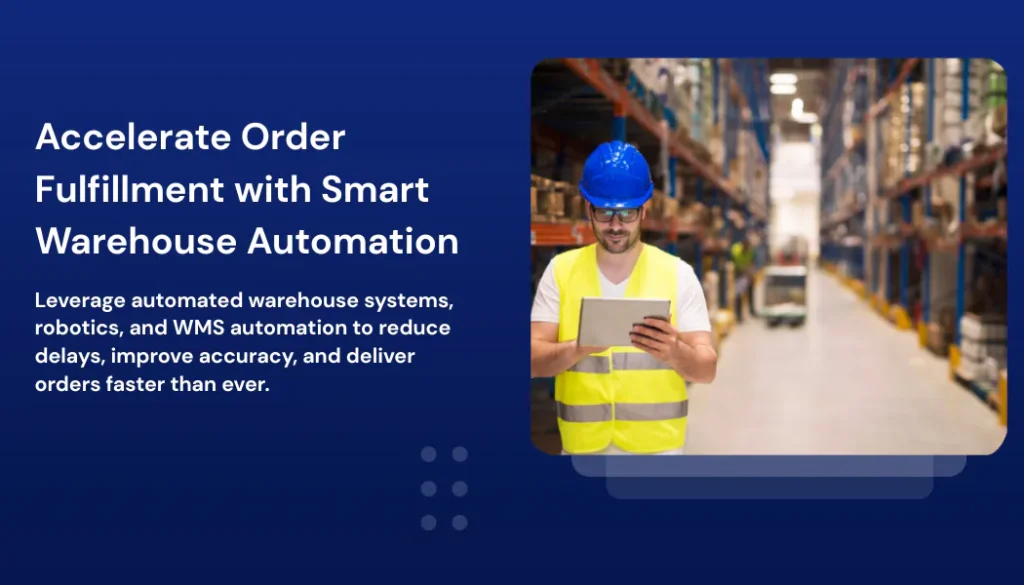
In business world, time is money and warehouse automation is directly impacting on the order fulfillment speed. Businesses competing in highly demanding sectors like fashion, beauty and retail, have huge pressure of fulfilling order faster, more accurately and in a cost-effective manner than ever before.
Think of it in a way that businesses are struggling with fulfilling the order faster and also managing the shrinking margins.
At MetaOption, we have witnessed firsthand how warehouse automation enhances delivery accuracy, expedite fulfilment time, and improved cost savings. Businesses that are recognizing and adopting this change early can fuel faster order fulfillment.
Here’s how MetaOption’s MetaWMS can help you automate the process:
Are all set for this transformation, but not finding the right strategy? If yes, then it’s time to first understand how warehouse challenges are impacting the business revenue and delaying the order fulfillment…
How Order Fulfillment Speed Impacting Your Success…
Being into managing warehouse operations, if you are keep ignoring the order fulfillment delays and constantly paying all the attention to just streamlining the workflow, then you are at high risk.
The order fulfillment time determines whether your ecommerce store will thrive or struggle against competitors. Here’s how it impacts your fulfillment speed…
Market stats and facts related to order fulfillment speed:
Customer expectations have compressed dramatically over the years from 5.7 days to 2.5 days in last 5 years and now shifted to 1.5 to same day delivery.
Order fulfillment speed directly impacts the revenue. When your delivery is takes longer than a week, reports says that there is a 38% of shoppers abandoning.
As per reports, two-day delivery is the new baseline for the warehousing. 64% of ecommerce orders are already meeting the new delivery timelines.
Why Warehouse Automation Matters Now More Than Ever Before?
Every year, with all the emerging technologies into warehousing and inventory management, the way warehouses were operated and customer’s expectations are changing. Same-day and Next-day shipping are now the new norm.
Not just that, customers want real-time tracking, perfect order accuracy, and rapid return processing. And during all such scenarios, if you are keep finding yourself stuck with labor shortages, rising wages and warehouse storage spaces- then it is high time for companies to automate warehouse operations.
Now the question is how does automation help in streamlining the warehouse operations and impacting on delivery speed.
Automated systems are designed to optimize flaws in the systems. From robotic picking systems to AI-powered inventory forecasting, automation empowers logistics providers to meet high-volume demand without facing any dip in operational control and transparency.
How Warehouse Automation Speeds Up Order Fulfillment
Now you know why and how automating in warehouse operations matters. But the central question is how warehouse automation is helping speed up order fulfilment…
Let’s get into it:
1. Material Handling Becomes Automated, Which Accelerates Movement
One of the biggest struggles that warehouses often facing is time sinking while moving products from receiving to storage, and then from storage to picking and packing stations.
With automated material handling systems like conveyors, Automated Guided Vehicles (AGVs), and Autonomous Mobile Robots (AMRs), you can better handle these movements fastly and reliably.
Core benefits of using automated material handling systems are:
- Reduce the physical burden on workers
- Eliminating delays caused by human pacing
- Controlling the risk of product breaks or missteps
- Conveyors and robotics maintain a consistent flow of goods 24/7
Key Impact: Material moves continuously and predictably, which help shrinking the time between order receipt and order processing.
2. Warehouse Robotics Ensuring Smarter Picking, Packing and Shipping
Order picking, selecting items from storage to fulfill an order, is a complicated process when there is a lack of automation.
Traditional warehouses rely on workers walking long aisles to locate products. With automation, smart picking bots and robotics take the lead and using sensors for detecting what products are stored in which direction.
These warehouse robots are equipped with sensors, and AI can retrieve items faster than humans, especially in high-density environments. Some systems even bring items directly to packing stations rather than requiring workers to walk to product locations.
This goods-to-person workflow minimizes travel time, minimizes the fulfilment bottleneck and speeds up picking and packing cycles without overworking staff.
3. Optimized Fulfillment Workflows With Automated Warehouse Systems
A Warehouse Management System (WMS) acts as the backbone of the entire system, from where is routing.
Modern WMS platforms like MetaWMS is integrated with robotics and real-time tracking tools like RFID to monitor inventory, assign tasks, and direct operations with precision.
Here’s how WMS automation accelerates fulfillment:
- Bringing the real-time visibility with centralized dashboard to know where every SKU are staying at all the times.
- Smartly allocating the tasks by prioritizing urgent orders and guide workers or robots on the most efficient order of tasks.
- Efficient routing by generating optimal pick paths with minimized movement.
- Instant Data Syncing and updating the fulfillment status across the system without any delay.
By reducing guesswork and coordination between activities, across the warehouse, WMS automation eliminates bottlenecks and accelerates fulfillment from start to finish.
4. Inventory Accuracy Eliminates Fulfillment Delays
Mistakes in inventory management like stockouts or misplaced items, can cause a major blunder. It can bring fulfillment to a grinding halt.
Since maintaining the inventory accuracy is the baseline, therefore, modern warehouse management systems like MetaWMS are already integrated with Automation technologies. From barcode scanning to AI-powered inventory tracking, it ensures that stock records are accurate and up-to-the-minute.
When your system “knows” exactly what’s in stock and where it’s located, retrieval becomes quicker and more reliable.
No more wasted time searching for missing items or recounting stock, hence fulfillment teams spend time fulfilling orders, not fixing inventory errors.
5. Throughout Inventory Automated Sorting & Packaging Speeds
Once items are picked, they move to sorting and packing, this is another area, where automation outshines.
High-speed sortation systems like automated belt sorters or sliding sorters, quickly group orders by destination or shipping priority which enable efficient batch processing.
Automated packaging systems can even handle routine labeling and boxing tasks, ensuring rapid and standardized packing that keeps fulfillment rolling smoothly without any drop in performance.
Result: Tasks once done manually are completed faster, with less variability and fewer mistakes.
6. Scaling Warehouse Operational Demands Without Any Breakdown
One of the hidden benefits of automation is elasticity. If your system has the ability to handle peaks without slowing down, then you can scale without any barriers.
During peak seasons, promotions, or unanticipated demand surges, automated systems maintain performance levels without stressing and hampering the labor capacity
Instead of scrambling to hire temporary staff or extend hours, warehouses equipped with automation adjust workflows and task priorities automatically, keeping fulfillment times tight and deliveries on schedule.
What’s the Success Rate of Warehouse Automation in the Real World
Let’s evaluate the warehousing case of global retailer “Decathlon”. After deploying advanced robots, one of its warehouses doubled its order preparation capacity and jumped straight from 57K to 114K orders.
This dramatic improvement highlights the true power of automation. With the adoption of advanced WMS and implementing automation, operational performance doesn’t just improve, it transforms.
How Does Order Fulfillment Automation Benefits Your Business
In modern business, speed is everything. Smart warehouse automation not just expedite the delivery time, but also ensuring values in other critical areas too:
- Improved Accuracy: Fewer errors mean fewer returns and happier customers.
- Lower Operational Costs: Automation reduces labor dependency and helps cut long-term costs.
- Safer Work Environment: Robots take on heavy lifting and reduce workplace injuries.
- Better Space Utilization: Automated systems maximize vertical storage and optimize layouts.
All of this contributes to a fulfillment ecosystem that’s lean, responsive, and future-ready.
How To Implement Warehouse Automation the Right Way
Introducing smart warehouse technology doesn’t have to be overwhelming. All you need is to adopt the right strategy and planning. Here’s a simple roadmap:
- Analyze Existing Challenges: Identify bottlenecks in picking, packing, and inventory tracking.
- Mindfully Choosong the Right Tools: Not every warehouse needs the same automation tech, start with what delivers the biggest impact.
- Integrate Modern WMS: A robust WMS lays the foundation for smooth automation.
- Test & Scale: Test solutions in one zone before rolling them out across the facility. Once it fits to the situation, you can consider implementing the other operations.
- Train Your Team: Training is important if you really want to leverage the complete potential of your Warehouse Management System.
Approach automation as a strategic upgrade, not just a technology purchase. The mindful adoption of WMS and atomation will help you unlock lasting improvements in fulfillment speed and reliability.
Final Words
In the highly competitive marketplace, where speed and accuracy define success, warehouse automation isn’t optional, it’s an urgent need. By leveraging automated systems and WMS automation strategy rightly, businesses can dramatically improve order fulfillment speeds, improving customer trust and reducing errors consistently.
For any company looking to future-proof its supply chain, automation offers not just efficiency, but a transformative leap toward operational excellence.
But what would faster fulfillment mean for your business? Let’s explore the best possibilities with MetaOption and an expert team. You can contact us by filling the enquiry form, our team will approach you and guide you with best solutions.
What is an automated warehouse?
An automated warehouse refers to the modern warehouses that uses robotics, software, conveyors, barcode scanning, and automated storage systems to move, store, pick, and ship products with minimal manual intervention. The automated warehouses more rely on technology and there will be less risk of errors or costly blunders.
What is the difference between warehouse automation and system automation?
The simple difference between warehouse automation and system automation is warehouse automation focuses specifically on automating physical warehouse operations like picking, packing, sorting and storage. Whereas system automation refers to automating digital flow of information.
What are the benefits of warehouse automation?
The core benefits of warehouse automation are:
Increase fulfillment speed
Improve order accuracy (up to 99%+)
Reduce labor dependency
Lower operational costs
Improve workplace safety
Maximize warehouse space utilization
Scale easily during peak demand