




Why Cost Predictability Matters In ERP Projects
Cost predictability in an ERP project is not just a matter of keeping the finance department happy but a key approach that contributes to a successful delivery, implementation, and eventual value. Once budgets are off track, the effects are felt in numerous, unanticipated locations: rollouts stalled, features not fully implemented, cutovers rushed, and angry users. I elaborate the business impacts, who cares most, concrete signals that predictability is working and practical levers you can pull to improve it below.
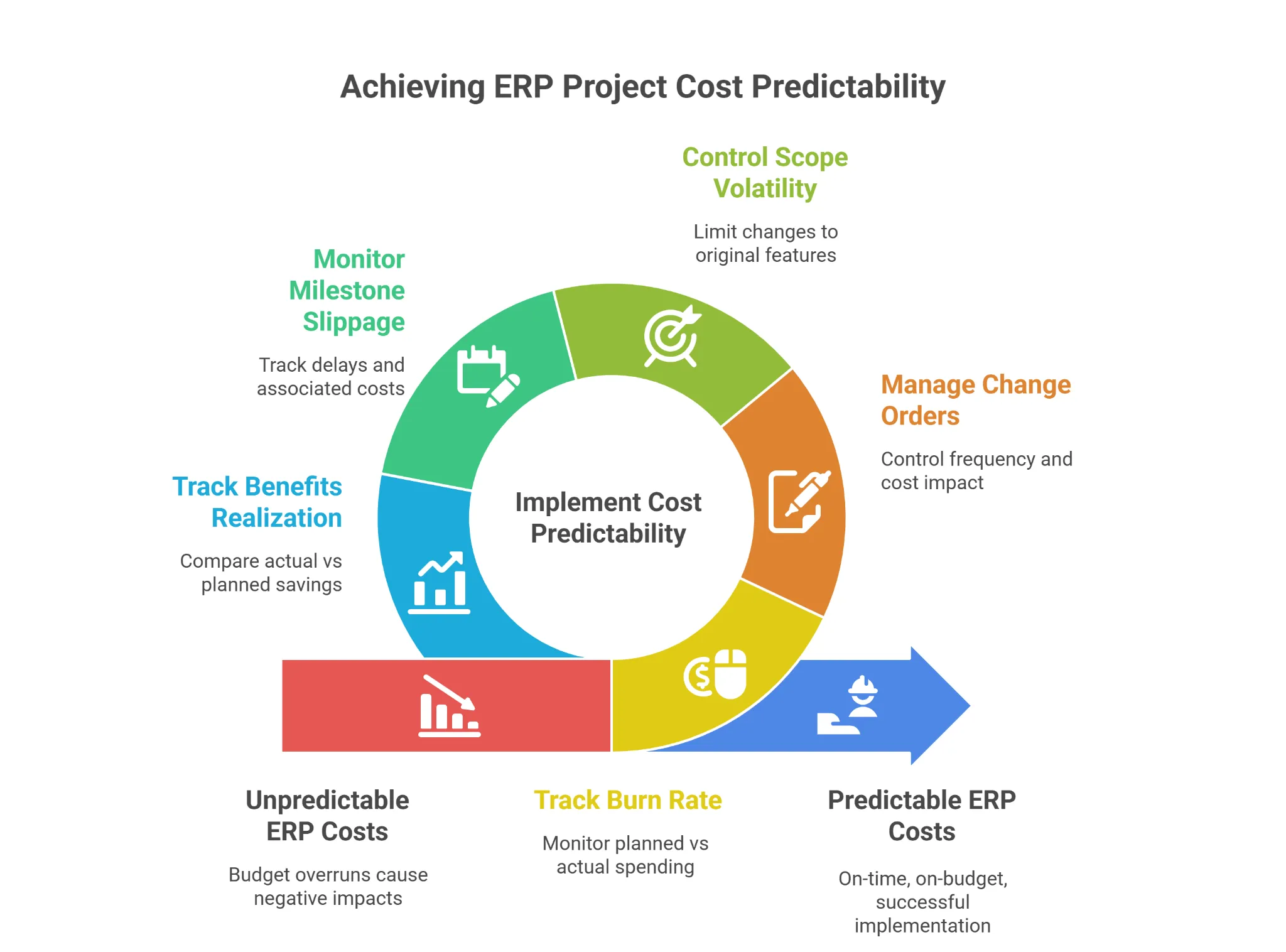
The business impact — what goes wrong when costs aren’t predictable
- Delayed value realization. Every unplanned dollar spent pushes the break-even point out. If implementation overruns, automation benefits, reduced headcount, or inventory savings arrive later — or not at all.
- Operational risk. Cost surprises often force short cuts in testing, training, or migration — the exact activities that reduce go-live risk. Those short cuts create outages, data errors, and unexpected manual work.
- Opportunity cost. Budget overruns divert capital and people from other strategic initiatives (new channels, product development, automation pilots).
- Stakeholder fatigue. Repeated overruns erode trust. Executives become hesitant to approve future digital investments and business teams resist change that appears risky.
Who needs predictability — and why they push for it
- CFO / Finance: needs reliable cash-flow plans and credible ROI timelines to satisfy boards and investors.
- CEO / Executive Sponsors: require predictable timelines to align strategy and go-to-market moves.
- Business Unit Leaders: want confidence that systems will be ready to support peak periods (promotions, launches) without hidden costs.
- IT / PMO: needs stable budgets to staff appropriately and avoid constant triage.
- Procurement: wants a contract model that balances certainty with flexibility and is simple to audit.
How you can measure predictability (practical KPIs)
Track a small set of actionable metrics rather than mountains of data:
- Planned vs Actual Burn Rate (weekly/monthly): immediate red flag for cost creep.
- Change Order Frequency & Cost Impact: number of approved changes and the cumulative budget they add.
- Scope Volatility: % of originally scoped features that changed by phase gates.
- Milestone Slippage: days delayed × associated cost impact.
- Benefits Realization Timeline: when expected savings or revenue uplift actually start flowing versus plan.
An Overview Of The Fixed Price Model
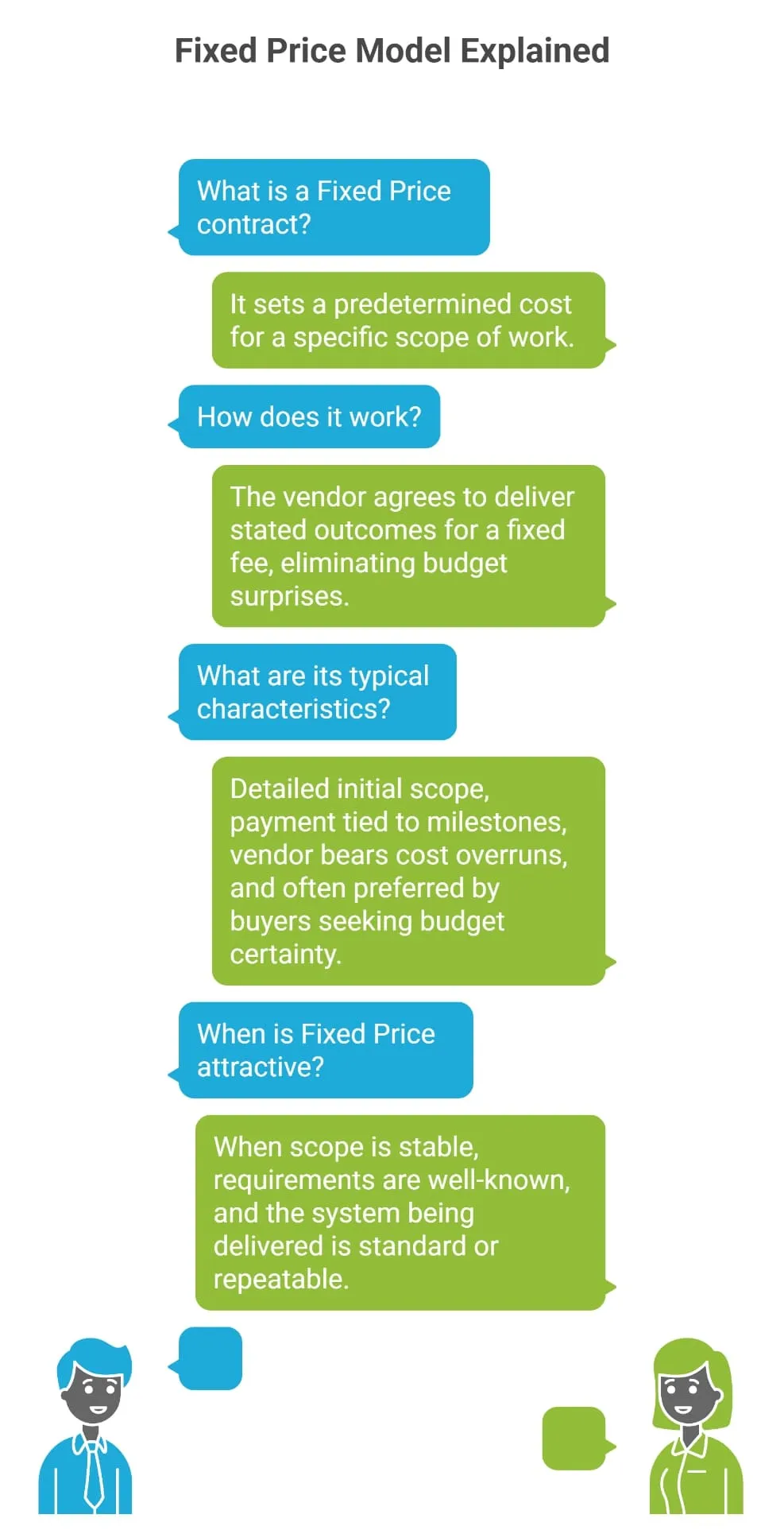
A Fixed Price contract sets a predetermined cost for a specific scope of work. The vendor agrees to deliver stated outcomes for a fixed fee. This model tries to eliminate budget surprises: scope is defined, price is set, and the vendor assumes much of the delivery risk.
Typical characteristics of Fixed Price:
- Detailed initial scope, often codified in a statement of work (SoW).
- Payment tied to milestones (analysis complete, configuration complete, go-live).
- Vendor bears cost overruns unless scope changes are mutually agreed.
- Often preferred by buyers seeking budget certainty.
Fixed Price is attractive when scope is stable, requirements are well-known, and the system being delivered is standard or repeatable. However, it can become expensive or rigid when unknowns appear—or when the buyer wants to evolve requirements mid-project.
An Overview Of The Time & Material (T&M) Model
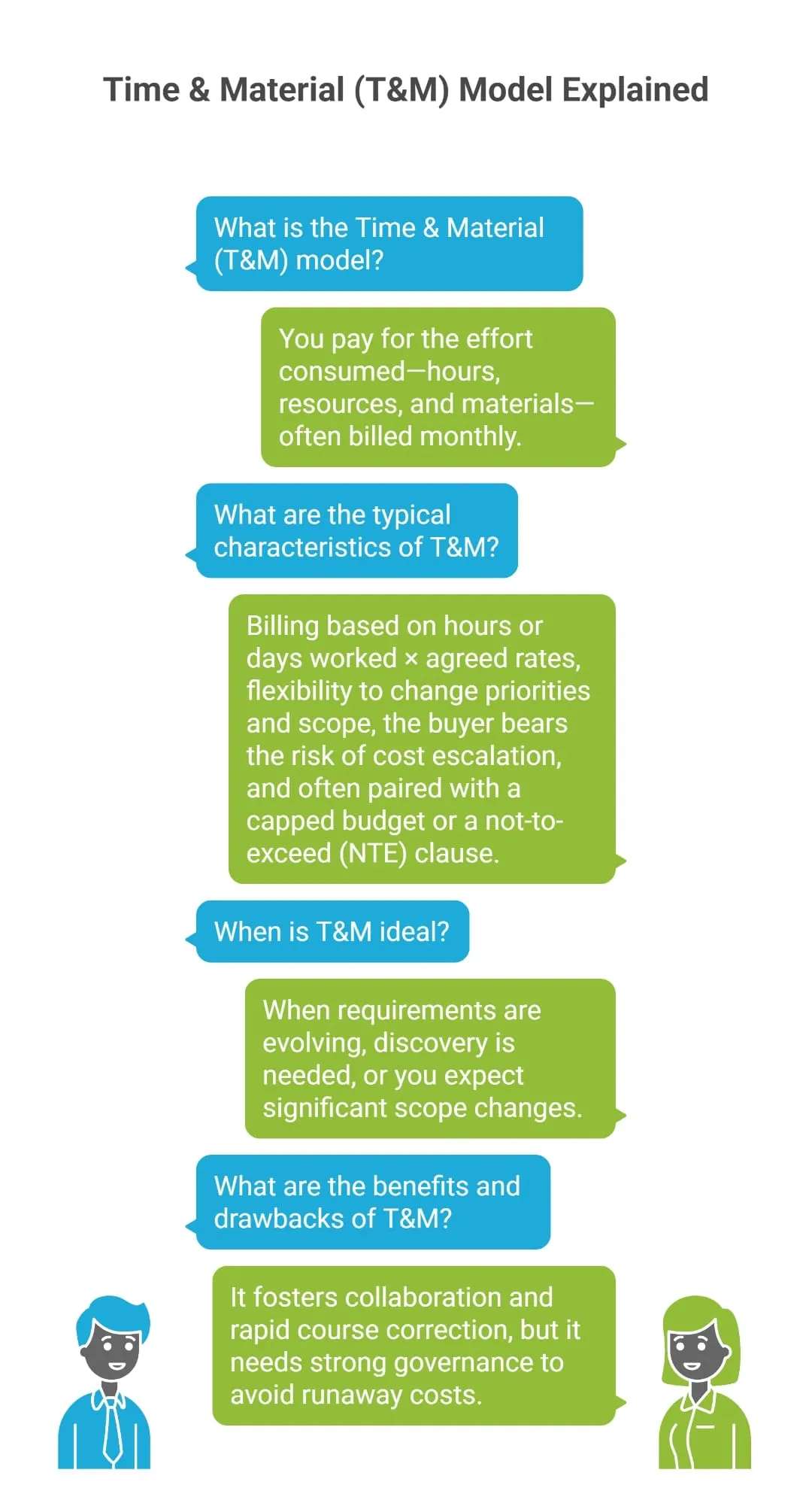
Time & Material means you pay for the effort consumed—hours, resources, and materials—often billed monthly. T&M aligns to an agile mindset: you can iterate, change priorities, and test assumptions without renegotiating the entire contract.
Typical characteristics of T&M:
- Billing based on hours or days worked × agreed rates.
- Flexibility to change priorities and scope.
- The buyer bears the risk of cost escalation if the project expands.
- Often paired with a capped budget or a not-to-exceed (NTE) clause for added control.
T&M is ideal when requirements are evolving, discovery is needed, or you expect significant scope changes. It fosters collaboration and rapid course correction, but it needs strong governance to avoid runaway costs.
Pros And Cons — Fixed Price (Pointer Section)
- Pros
- Predictable budget: known total cost if scope is stable.
- Clear vendor accountability for delivery to scope.
- Easier for finance to approve and forecast.
- Less internal management overhead—vendor handles planning.
- Cons
- Rigid scope: changes can be costly and slow (change orders).
- Risk of vendor over-engineering to protect margins or under-delivering where scope is ambiguous.
- Lower flexibility for iterative design or discovery-driven work.
- Potential for adversarial change control processes that slow progress.
- Best When
- Requirements are well-documented and unlikely to change.
- You’re implementing standard modules with proven templates.
- You prioritize fixed budgets over flexibility.
Pros And Cons — Time & Material (Pointer Section)
- Pros
- Flexibility to adapt scope, prioritize, and iterate.
- Easier to accommodate discovery work and unknowns.
- Encourages collaborative, agile delivery.
- Faster start—less time spent perfecting the SoW.
- Cons
- Less budget certainty; costs can grow without governance.
- Requires strong internal project management to control scope and pace.
- Can create the perception of vendor “billable hours” vs outcomes.
- Potential for resources to be reallocated mid-project, affecting continuity.
- Best When
- Requirements are uncertain or will evolve.
- You plan an iterative, agile approach with frequent demos.
- You want to prioritize speed-to-value and experimentation.
How To Decide Between Fixed Price And T&M (Two-Paragraph Section)
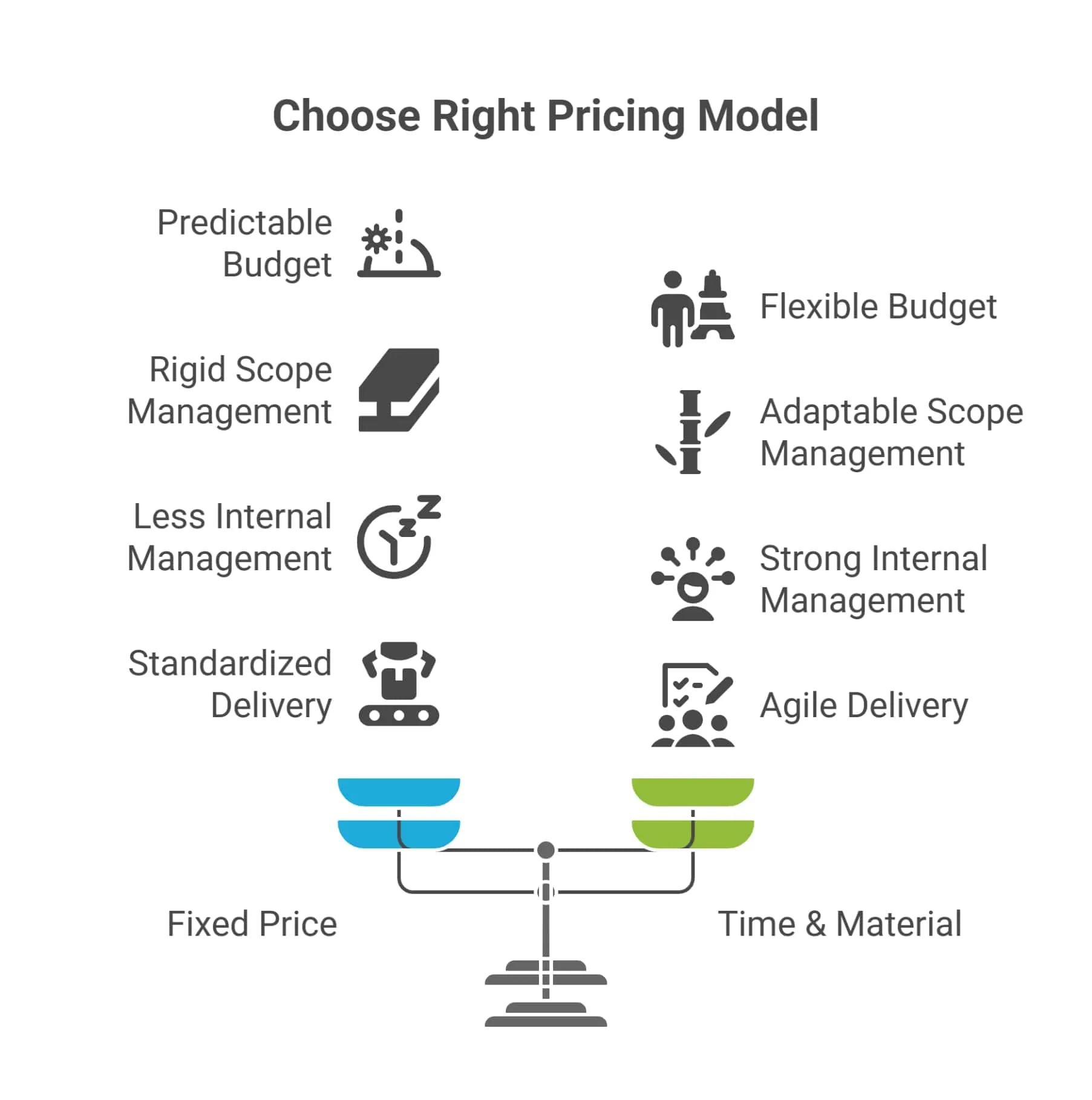
Fixed Price and T&M begins with the clarity of your requirements. Fixed Price is likely to offer the cost predictability you desire in case you can define the scope: detailed business processes, data locations, integrations, and acceptance criteria. Fixed Price works best in well-known implementations: simple modules deployment, industry templates, or where compliance requirements are different based on regulations. In this instance, add potent acceptance tests, change-order procedures, and performance SLAs to decrease vagueness and safeguard the two parties.
When, however, you do not know–undocumented processes in old systems, numerous integrations or transformations that require discovery–then T&M often beats Fixed Price because you can learn-and-adapt without renegotiation. Lack of control and flexibility is an invitation to cost creep. To make T&M predictable, combine it with hard sprint planning, prioritized backlog, time boxed phases, transparent burn reports and a budget constraint (e.g. staged amounts not to exceed). The latter approach is a flexible one and will give the CFO a comfortable feeling.
Practical Hybrid Approaches That Combine The Best Of Both
You don’t always need to pick extremes. Hybrid models are common and pragmatic:
- Fixed Price for Known Core, T&M for Discovery: Make core foundational scope fixed (e.g., chart-of-accounts migration, basic configuration) and use T&M for exploratory modules or integrations.
- Milestone-Based T&M With Caps: Use T&M but define phase budgets (Phase 1 discovery $X, Phase 2 build $Y), after which parties re-assess.
- Outcome-Based Incentives: Pay a base T&M rate but add fixed bonuses for hitting KPIs, go-live dates, or user adoption targets.
- Ring-Fenced Contingency: Fixed Price contract with a reserved contingency pool for unknowns that the client controls.
These hybrids align incentives, retain flexibility, and improve predictability when designed well.
Common Contract Clauses To Protect Cost Predictability (Two-Paragraph Section)
Good contracts do not have to be full of legalese, but they should be clear in their operations. In Fixed Price deals, the Statement of Work (SoW) is especially worth attention: acceptance criteria, definition of deliverables, items not included, and a well-defined change control process. Add penalty or remediation provisions in the event of missed milestones and indicate performance and uptime SLAs where relevant. Also critical are data migration tasks–specify who will perform data cleansing, data mapping, and data reconciliation so that remediation costs do not emerge in the future.
Be open and controlled in case of T&M contracts: timesheets per day/week on the basis of named resources, frequent burn reports and a clear escalation matrix. Add a not-to-exceed (NTE) limit or vendor signature to continue beyond pre-determined budget stages. Implement also knowledge-transfer clauses, resource continuity guarantees (e.g. minimum seniority or transition overlap) and defined review gates at which leadership evaluates progress, scope and costs. These provisions prevent T&M to be an open checkbook.
Risk Allocation And Incentives
Risk allocation is at the heart of any cost model decision. Fixed Price shifts risk to the vendor; T&M shifts it to the buyer. But pure risk transfer rarely produces ideal outcomes. Vendors may pad bids, and buyers may under-resource governance. Instead, structure incentives:
- Use shared KPI-based bonuses (on-time, within budget, adoption rates).
- Include rollback and remediation plans tied to vendor performance.
- Build a governance board with vendor and client leadership that meets weekly/biweekly.
- Insist on transparent dashboards showing progress, burn rate, and outstanding risks.
When risks and rewards are shared, vendors are more likely to be collaborative rather than defensive.
Real-World Scenarios And Recommendations
- Scenario: Small Company Implementing Standard ERP Modules
If you’re a small organization implementing standard financials and purchasing modules with minimal integrations, a Fixed Price model with tight SoW and a short discovery phase often makes sense. You get budget certainty, and the vendor can leverage repeatable templates. - Scenario: Large Enterprise With Legacy Systems
For a large enterprise with multiple legacy systems, complex integrations, and ongoing transformation requirements, T&M with phased budgets or hybrid splits is the safer route. The initial discovery sprint should be T&M to uncover unknowns; after that, move to fixed-price sprints for well-defined work. - Scenario: Rapid Innovation Or Frequent Regulatory Change
When your industry sees fast regulatory shifts or you’re experimenting with advanced functionality (AI, IoT integrations), choose T&M. The flexibility will let you pivot quickly without costly change orders.
Governance: The X-Factor For Predictability (Pointer Section)
- Executive Sponsor And Steering Committee: Ensure executive buy-in and regular steering meetings to resolve decisions quickly.
- Product Owner / Business Lead: A named point of contact to prioritize features and approve scope changes.
- Weekly Burn Reporting: Transparent dashboards showing hours, costs, and remaining budget.
- Sprint Reviews & Acceptance Tests: Regular demonstrations with tangible acceptance criteria.
- Change Control Board (CCB): A lightweight process for approving scope changes with cost and timeline implications.
- Contractual KPIs: Uptime, defect rates, user adoption thresholds, and remediation SLAs tied to payments.
Good governance turns T&M into a controllable, predictable model and makes Fixed Price less brittle.
How Procurement Should Evaluate Proposals
Procurement shouldn’t chase the cheapest headline price. Instead, evaluate proposals on:
- Clarity of scope and assumptions.
- Vendor’s past performance in similar ERP projects.
- Proposed governance and reporting mechanisms.
- Resource continuity plans (who will actually do the work).
- Escalation procedures and remediation commitments.
Ask vendors to provide references and real burn-rate examples from similar engagements. When comparing ERP project cost models, you’re buying predictability as much as you’re buying service.
Why Transparency And Communication Matter
Cost predictability at the end of the day relates less to the type of contract and more to transparency. Regardless of Fixed Price or T&M, the project should have effective communication between the development teams daily, the executives weekly, and the stakeholders through real-time dashboards. Periodically re-examine assumptions-what was not known at the beginning may be known in week two and timely reporting prevents surprises that turn into change orders or scope creep.
Final Recommendations
- Use Fixed Price when: you have clear requirements, repeatable implementations, and a low tolerance for budget variance. Build defenses—robust SoW, acceptance tests, and clear exclusions.
- Use T&M (or hybrid) when: discovery is required, integrations are complex, or you want agility. Combine T&M with strict governance, phase caps, and transparent burn reporting to maintain control.
- Consider hybrid models as practical middle ground—fix the known, flex the unknown.
- Always include governance, KPI-linked incentives, and knowledge-transfer clauses to preserve predictability regardless of contract type.
ERP project cost models are a strategic choice. It has an influence on vendor behavior, project pace, and whether your ERP investment will be a growth base-or a costly legacy. Be intentional: clarify the predictability that is desired in your organization, align that with the appropriate contract structure, and inculcate governance into each stage.
For more information and a tailored demonstration, contact us today at MetaOption.