



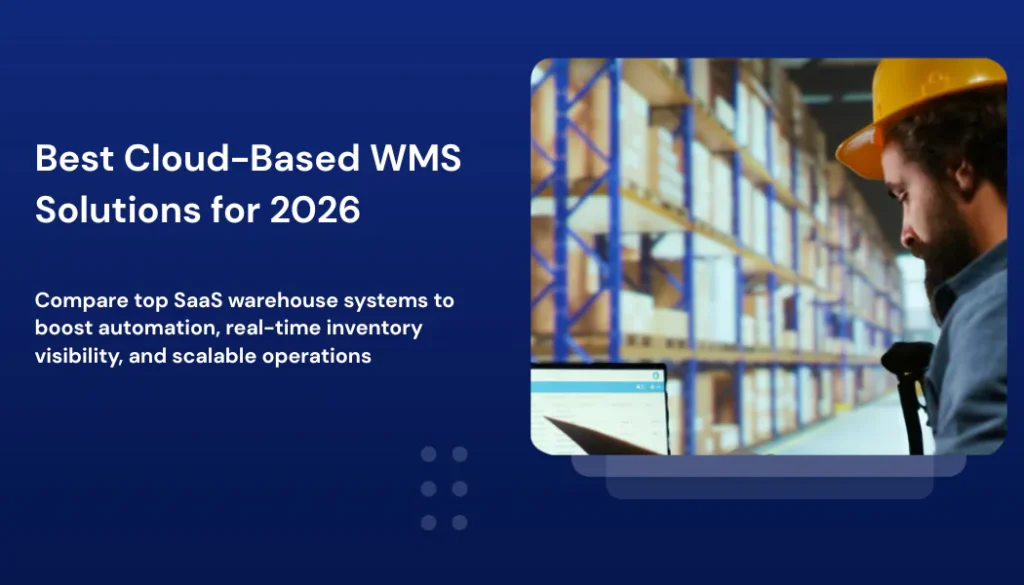
Are you also surprised to know, why increasing number of supply chain businesses are switching to cloud based WMS?
Well if you are running warehousing on legacy systems or relying on spreadsheets, you are already far behind the market competition. And numbers are proving it true…
According to reports, companies claimed that modern warehouse management systems bring 25-70% of increase in productivity and improve inventory accuracy by 99.5%.
90% of supply chain operators say that they encounter significant warehouse operational challenges due to outdated warehouse management technology.
With that said, it is predicted that WMS global market will reach from $4.9 billion in 2025 to $20.28 billion by 2034 at the CAGR of 17.1%.

With the rising and constantly changing customer expectations, increased volumes, and complex multi-location operations, businesses are in urgent need of SaaS WMS platforms that offer real-time inventory visibility, deep automation, and seamless integration with existing systems.
Now the central question is, which are the best cloud WMS software solutions in 2026 trending and can best fit modern business needs?
Here we have a complete competitive listicle providing a detailed description of cloud-based WMS for small, midsize to large enterprises but before it let’s learn what is a warehouse management system (WMS)?
Upgrade to a Smarter Cloud WMS
Improve inventory accuracy and streamline warehouse operations with ease.
Top Cloud-Based WMS Software To Look Forward in 2026
Here are the quick and easy to access top cloud-based WMS solutions you can consider in 2026 to streamline supply chain operations.
Some solutions are built for global enterprises running robotic fulfillment centres, while other target fast-growing distributors or ecommerce brands. A few are deeply integrated with ERP ecosystems, while others operate as standalone systems. Different businesses has different needs, therefore various WMS solutions comes with their own strengths.
Choosing the wrong system can lock your warehouse into operational bottlenecks for years. So before you make any decision, let get into the details of best cloud-based WMS systems in 2026…
10 Best Cloud-Based Warehouse Management Systems: Capabilities, Strengths, Limitations, and Pricing Tier
1. MetaWMS Powered By MetaOption
Best For: MetaWMS is purposefully developed for Microsoft Dynamics 365 Business Central users, distributors, manufacturers, and mid-size scaling businesses.
MetaWMS is intelligently designed for companies that are already handling operations with the Microsoft ecosystem. Unlike generic warehouse tools that rely on connectors, MetaWMS integrates directly into Dynamics 365 Business Central, creating a tightly unified operational environment and allowing you to control warehouse use management operations through one defined solution.
For businesses seeking a modern cloud warehouse solution without disrupting their ERP foundation, they can take the privilege of MetaWMS.
Core Capabilities of MetaWMS
- Offering mobile barcode & RFID scanning
- Smart put-away and picking
- Batch & wave picking workflows
- Lot & serial tracking
- Multi-location warehouse management
- Automated replenishment triggers
- Integrated shipping & carrier workflows
MetaWMS is significantly strong WMS for SMBs that are migrating from the basic to upgraded solutions or even needing the enterprise-grade functionality without complexity.
Strengths
- Native BC integration
- Faster implementation compared to a large enterprise WMS
- Ensuring real-time operational visibility inside ERP
- Strong distributor & manufacturing alignment
Limitations
- Best suited for users relying on the Business Central Ecosystem
- Advanced robotics integrations may require customization
Pricing Tier
Offering custom and flexible subscription-based pricing models that may vary depending on warehouse complexity.
ERP Compatibility
- Microsoft Dynamics 365 Business Central (native)
- Microsoft ecosystem integrations
2. Oracle NetSuite WMS
Best For: Mid-to-large-sized businesses relying on NetSuite ERP.
Oracle NetSuite WMS is tightly integrated within the NetSuite cloud ERP environment, allowing you to access synchronized warehouse and financial operations.
Core Capabilities
- Intelligently managing the Bin
- Wave picking
- Barcode scanning
- Error-free cycle counting
- Multi-location control
Strengths
- Native NetSuite
- Unified data model
Limitations
- Higher subscription cost
- Best value when fully embedded in the NetSuite ecosystem
Pricing Tier
Mid to enterprise (custom quote-based).
ERP Compatibility
- Oracle NetSuite (native)
3. SAP Extended Warehouse Management (EWM)
Best For: Large enterprises handling the global distribution complexity.
SAP EWM is designed to manage high-volume, high-complexity warehouse environments where deep process controls are required.
Core Capabilities
- Advanced slotting and inventory management
- Labor management and resource optimization
- Seamless yard management
- RFID integration and Barcode scanning
- Automated material flow systems
Strengths
- Extremely robust functionality
- Deep SAP S/4HANA integration
- Ideal for global enterprises
Limitations
- Complex implementation and higher time for integration
- High cost of ownership and maintenance
Pricing Tier
Offering enterprise-level custom licensing and implementation pricing.
ERP Compatibility
- SAP S/4HANA
- SAP ECC
4. Manhattan Active WMS
Best For: Warehouses handling high-volume retail and 3PL operations.
Manhattan Active is known for deep warehouse automation capabilities and advanced fulfillment orchestration.
Core Capabilities
- AI-driven task optimization
- Robotics integration
- Labor forecasting and optimization
- Distributed order management
Strengths
- Built for automation-heavy environments
- Strong scalability
- Cloud-native architecture
Limitations
- Expensive pricing model with premium features
- Complex onboarding which take long time for implementation
Pricing Tier
Custom pricing which is usually affordable to large-scale enterprises.
5. Infor CloudSuite WMS
Best For: Businesses looking for centralized control for managing multi-site operations.
Infor CloudSuite WMS is crafted to offer strong visibility over warehouse inventory management. It provides industry-specific functionality for manufacturing and distribution.
Core Capabilities
- 3D warehouse visualization
- Advanced analytics dashboards
- Multi-warehouse synchronization
- Labor tracking and resources utilization
Strengths
- Flexible configuration
- Good analytics layer
- Broad ERP connectors
Limitations
- Complex requirements may require customization can increase cost
- Your team may require training to understand UI
Pricing Tier
Mid to enterprise level of subscription-based pricing model.
6. Softeon WMS
Best For: For warehouses looking for third-party logistics providers.
Softeon specializes in multi-client warehouse environments, therefore providing warehouses with advanced billing and automation features to manage inventory records with accuracy.
Strengths
- Offering 3PL billing capabilities
- Scalable multi-tenant architecture
- Automation-ready
Limitations
- Seems more complex for single-site warehouses
Pricing Tier
Offering a flexible pricing model suited to small to mid-size businesses.
7. Körber WMS (HighJump)
Best For: Handling complex distribution networks.
Körber provides adaptable workflows and strong configurability for high SKU environments or businesses that are scaling with rapidly increasing SKUs.
Strengths
- Highly configurable
- Good automation integrations
- Global deployment capability
Limitations
- Configuration may take a long implementation time.
Pricing Tier
Offering a fixed pricing model ranging from mid-to-high, depending on the warehouse management requirements.
8. Fishbowl Inventory
Best For: Small to mid-sized businesses, looking for simple warehouse control.
Fishbowl integrates well with QuickBooks and provides essential warehouse features to streamline warehouse management operations.
Strengths
- Affordable
- Easier deployment
- Good for smaller teams
Limitations
- Limited options to access advanced system automation.
- Not ideal for scaling businesses with increasing SKUs.
Pricing Tier
Starter to mid-tier subscription.
9. Zoho Inventory
Best For: Startups and small businesses managing basic inventory workflows.
Zoho provides entry-level capabilities with strong usability and low subscription costs.
Strengths
- Budget-friendly
- Easy onboarding
- Strong integration marketplace
Limitations
- Limited control for enterprise level functionaries
10. ShipHero / ShipBob
Best For: eCommerce brands who prioritize fulfillment speed.
These platforms combine fulfillment services with software-driven inventory management.
Strengths
- Strong for DTC brands
- Fast order processing
- eCommerce integrations
Limitations
- Not full enterprise WMS replacements
Cloud-Based Warehouse Management System: How Much Does a Cloud WMS Cost in 2026?
No matter for what reasons you are migrating or updating your warehouse management system, the the implementation cost remains one of the most pressing concerns for the businesses. So how much you do need to expect to spend in cloud WMS software.
However, focusing only on monthly subscription pricing can be misleading. A structured cost evaluation includes both direct and indirect investments.
1. Entry-Level WMS for Small Businesses With Simple Operational Needs
Typical Expected Range: $100–$500 per month
Includes
- Basic inventory tracking
- Barcode scanning
- Single warehouse support
- Limited automation
Best for startups or smaller warehouses with straightforward workflows.
2. Mid-Market Subscription Tier For Scalling Businesses
Typical Range Include: $500–$3,000 per month
Includes:
- Multi-location support
- Directed picking & put-away
- Reporting dashboards
- ERP integration
- Moderate workflow automation
This is the most common tier for distributors and manufacturers who have been scaling with their operations.
3. Enterprise Deployment with Complex Warehouse Management Needs
Pricing Brackets: Custom or high depending upon complex needs
Includes:
- Robotics integration
- AI-driven analytic and forecasting
- Advanced labor management
- AI-driven optimization
- Global warehouse visibility
- Multi-region deployment
Suitable for large retail networks and global supply chains.
Additional Cost Factors to Consider
- Implementation services
- Data migration from NAV to BC
- Hardware requirements including Barcode or RFID Scanners
- Custom workflow configuration
- Training & onboarding
- Ongoing support
The true evaluation metric is total cost of ownership over 3 to 5 years, not just subscription cost.
What Decision-Makers Should Prioritize in 2026 To Choose Best Cloud-Based WMS?
Choosing the best cloud based WMS is no longer about having a tool that does basic stock control. It’s about operational intelligence and scalability.
Here are the five critical evaluations you need to do before you make any final decision about choosing the Cloud-based WMS in 2026…
Real-Time Inventory Visibility
Modern warehouses cannot rely on batch updates that are supposed to be done at the end of the day. Systems must provide real-time inventory visibility across bins, locations, and sales channels to prevent stockouts and fulfillment delays in all scenarios.
Check for Automation Depth
Warehouse inventory tracking and automatically data update isn’t enough for the businesses. Check for strong warehouse automation capabilities that include wave picking, intelligent routing, replenishment triggers, and robotics compatibility which directly influence order accuracy and labor productivity.
Hassle-Free ERP Integration
Loose integrations create reconciliation issues. Native ERP alignment reduces duplication, improves reporting accuracy, and accelerates financial visibility.
Multi-Location Control and Scalability
A WMS must support:
- Multiple- location warehouses
- Growing SKU counts
- International expansion
- Omni-channel fulfillment
Architecture matters the most in WMS, than the feature count.
Deployment Agility
Cloud deployments allow faster upgrades, lower infrastructure burden, and easier expansion compared to legacy systems.
Why Adoption of Modern Cloud Warehouse Platforms Is Accelerating in 2026?
Digital transformation in supply chains is now driven by necessity. Now organizations are investing in modern systems because:
- Customer expectations are shifting to faster delivery or same-day delivery.
- Labor costs continue rising, and need more optimization.
- Inventory volatility requires accurate forecasting to avoid overstocking or understocking.
- Multi-channel selling increases complexity and needs automation.
- IT leaders prefer subscription-based infrastructure rather than relying on manual spreadsheets.
A well-implemented cloud warehouse solution reduces operational friction while improving decision accuracy.
The competitive gap between digitally mature warehouses and legacy operations is widening each year, and smart warehouses are opting for the intelligent cloud-based WMS solutions for easy scaling.
Final Recommendation: Choosing the Right WMS for Your Growth Strategy
There is no universal “best” system exists that fits to all needs. Only the best alignment between your operational complexity, ERP ecosystem, and growth roadmap can happen with the right choice of WMS.
- Global enterprises with advanced automation needs often lean toward SAP or Manhattan.
- NetSuite-native businesses benefit from staying within that ecosystem.
- 3PL providers typically require Softeon or comparable multi-tenant solutions.
- Growing distributors and manufacturers using Dynamics 365 Business Central should prioritize tightly integrated solutions like MetaWMS for faster implementation and operational transparency.
The right decision is strategic, not purely technical.
A warehouse management system is not just software, it is infrastructure for operational growth.
Final Words
In 2026, as the warehousing needs are changing, it has become important to select a cloud-based WMS. But choosing the best Warehouse Management Software always remains a strategic decision, as apart from cost, you need to evaluate multiple factors.
The right system should strengthen operational control, reduce execution risk, and support long-term scalability without constant reinvestment.
Decision makers who prioritize visibility, automation maturity, integration strength, and deployment flexibility will position their warehouses for sustainable growth.
With deep market research and analysis, we have gathered the data and listed the top cloud-based WMS solutions that can streamline your warehouse operations and offer automation maturity. Each solution has its own strengths and limitations; the final choice will depend upon your requirements.
Choose a solution that supports your future needs, not just your current volume. For more details and guidance, you can contact us.
What is a cloud-based WMS?
A cloud-based WMS is a warehouse management system hosted on remote servers and accessed through the internet. It manages inventory, order fulfillment, picking, shipping, and warehouse workflows without requiring on-premise infrastructure. Updates, security, and maintenance are typically handled by the provider, reducing IT overhead while improving scalability.
How is it different from on-premise?
On-premise systems require internal servers, manual upgrades, and larger upfront investments. Cloud systems operate on subscription models, deploy faster, and scale more easily. They also offer remote accessibility and automatic updates, which reduce long-term maintenance burden.
How much does a cloud WMS cost?
Costs vary widely based on complexity. Entry-level systems may start under $500 per month, while mid-market solutions range from $500 to several thousand monthly. Enterprise systems require custom contracts. Implementation, customization, and hardware should also be factored into total investment.
Which cloud WMS is best for small businesses?
Small businesses often benefit from simplified platforms like Zoho Inventory or Fishbowl due to lower cost and easier deployment. However, growing distributors using Microsoft Dynamics may find more long-term value in solutions like MetaWMS that scale with ERP expansion.
Can cloud WMS integrate with ERP?
Yes. Most modern platforms integrate with major ERP systems such as Microsoft Dynamics, NetSuite, SAP, and others through native connectors or APIs. Native integrations typically offer better data synchronization and reporting accuracy than third-party connectors.