




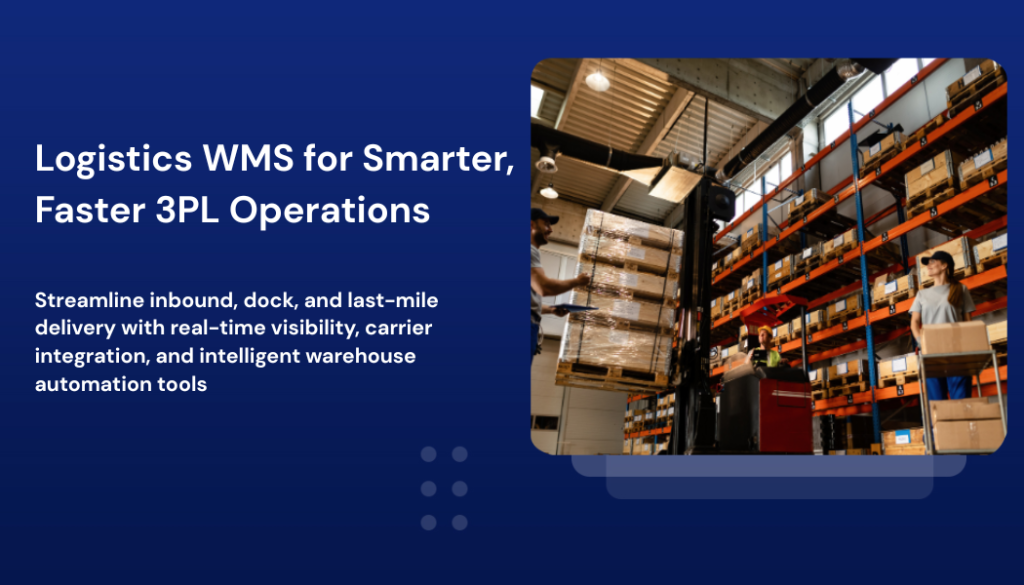
Logistics WMS has become the operational backbone of any modern 3PL company and logistics managers. If you are still ignoring it, then you are walking on the edge…
Walk into any high-volume warehouse, and you’ll likely see the same problem playing out at scale- the trucks are queuing at the dock because no one knows which door is free, pickers walking twice the distance as inventory is not yet slotted. The shipping teams are manually hunting and comparing the best carrier rates.
Well, none of these is the operator’s problem- it’s a system barrier…
This is where adopting logistics WMS software is a smart move, adding a structured layer to operations and ensuring everything moves in the right way.
See MetaWMS in Action- Built For Modern Logistics Needs
Explaining how MetaOption’s MetaWMS transforms warehouse operations. It is designed to deliver end-to-end warehouse visibility, from inbound receiving through last-mile dispatch. Watch the demo to see how it connects dock, yard, and carrier operations in a single dashboard.
Why Logistics WMS Matters: The Adoption Number Behind It
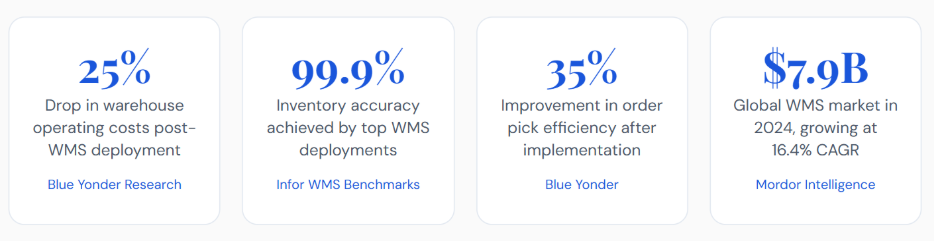
The global supply chain is rapidly changing and demanding modern logistics solutions. The research from Blue Yonder and Infor highlights that 3PL logistics companies are facing:
- Increasing SKU proliferation
- Multi-node fulfilment networks
- Real-time customer visibility expectations
- Labor shortages and dock congestion
- Pressure to reduce transportation and warehouse costs simultaneously
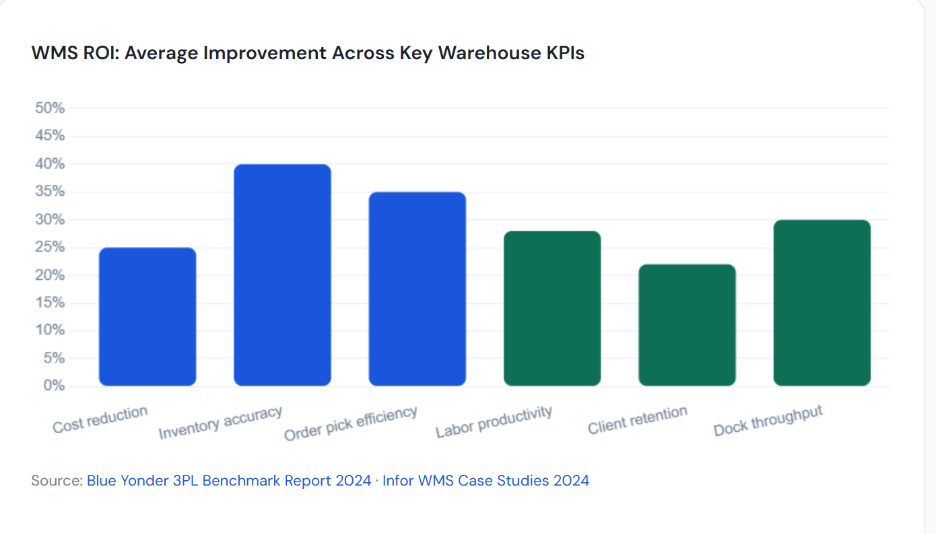
But warehouses that realise it at an early stage and deploy a purpose-built WMS see measurable improvements across every major operational KPI, and the ROI typically arrives within the first year.
How WMS Fits Into the Logistics Ecosystem?
A warehouse isn’t a standalone system- it’s a operational hub that connects every layer of your logistics technology stack and tools working to streamline the operations.
Think of it as the controlling system that sits between your planning systems (ERP, OMS) and your physical execution layer (carriers, automation, dock equipment).
When all your systems and tools are capable of talking to each other through a well connected WMS, you stop making decisions based on spreadsheets that are weekly updated. With real-time data update, you start reacting to what’s actually happening on the floor in the real time.
According to Infor, companies running integrated WMS ecosystems reduce unplanned inventory adjustments by up to 40% compared to complex warehouse systems.
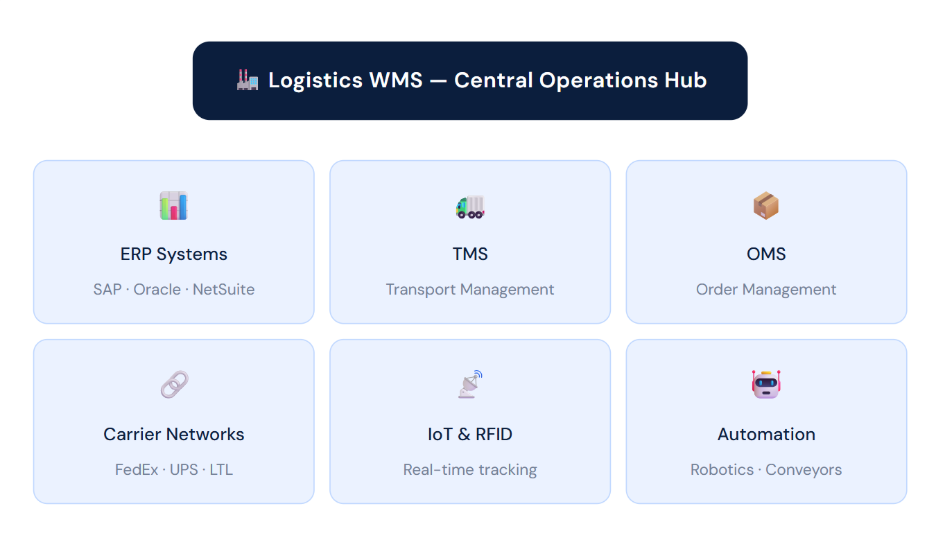
Here, let’s understand how each component of logistics operation fits into WMS:
- Inbound Logistics Optimization
Most warehouse inefficiencies don’t start at the pick face, they actually start at the receiving dock, hours before a single item is put away.
Freight usually arrives without proper notice and this is where dock teams are scrambling to figure out what’s on the truck, and putaway happens ad hoc rather than by design. But a logistics WMS starts planning and managing this right from the moment a PO is raised.
Now the question is how it works and what it handles?
With Advance Shipment Alerts flowing directly into the WMS, your team always stays updated with what’s coming, when it’s arriving, and exactly where it needs to go before the truck even backs in.
This makes receiving a directed activity, not a reactive one, where every item is scanned against the expected receipt, exceptions are flagged immediately, and putaway is driven by system logic depending upon the size, product type, temperature zone, and more.
The Real Impact: Blue Yonder’s research shows warehouses with WMS-driven inbound processes reduce receiving cycle times by up to 32% and cut putaway errors by 45% as compared to manual receiving workflows. Blue Yonder 2024
- Yard Management and Dock Scheduling
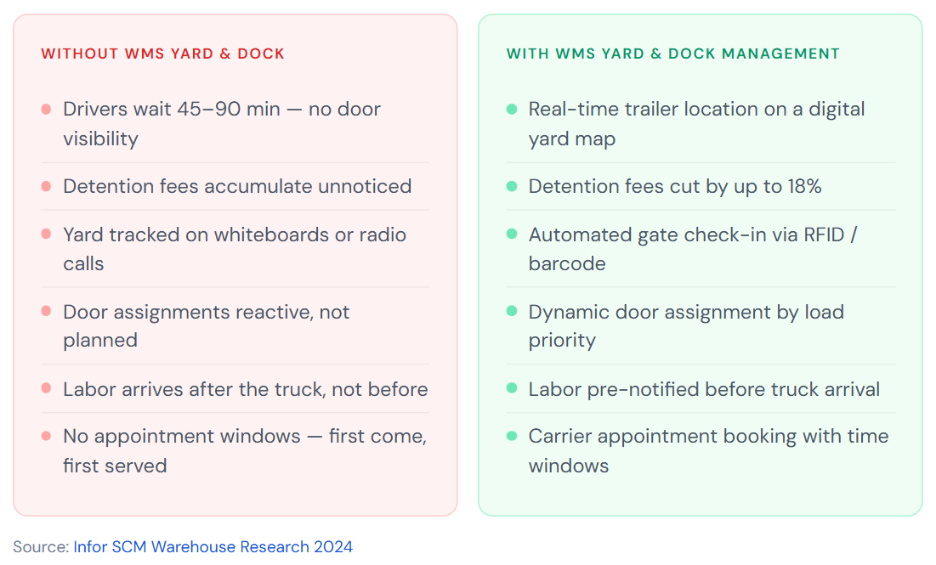
Here’s a scenario that almost every warehouse faces every day- where a truck arrives on time, but the assigned dock door is still occupied.
In that case, the driver waits, and detention fees tick up. Meanwhile, two other doors are sitting empty because no one has real-time visibility into the yard.
This is a coordination problem, and an integrated WMS with yard and dock management brings a complete picture in front of the warehouse operators.
Yard management extends your WMS beyond the four warehouse walls. Every trailer in your yard gets a digital identity and provides a real-time yard map.
The Logistics WMS ensures that gate check-ins work automatically using barcode or RFID scanners.
In addition, Dock scheduling takes this a step further by layering appointment management on top. Carriers book time slots in advance, and the system balances inbound and outbound appointments by checking the door availability, pre-assigning labor, and notifying receiving teams automatically when a truck checks in.
During peak season, this level of coordination makes a huge difference between a warehouse that absorbs volume spikes and one that collapses under them.
- Carrier Integration & Freight Management
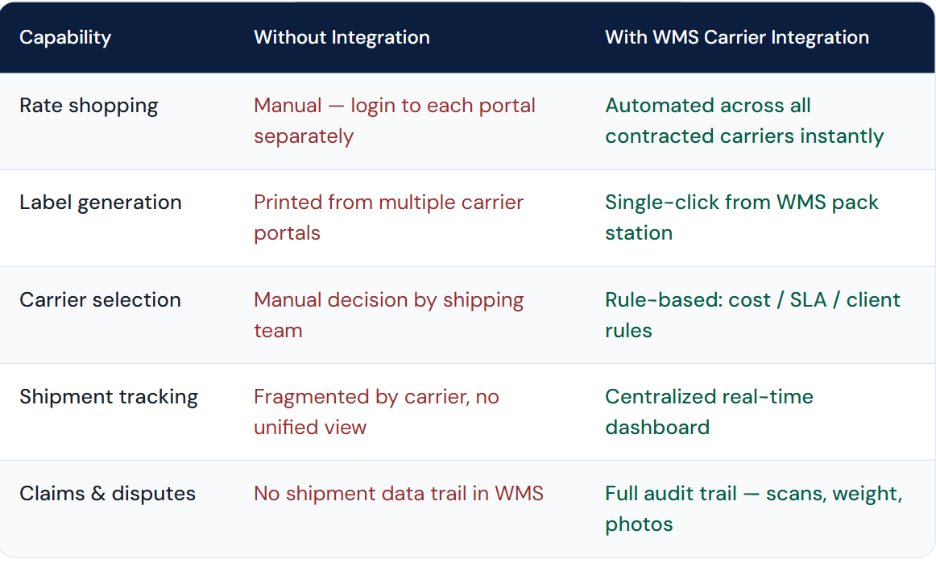
Most of the shipping managers are still selecting a carrier for a given shipment using spreadsheets and manually checking the portals.
Without even realising how this process is costing time, introducing errors, and consistently leaving money on the table. Native carrier integration inside a logistics WMS replaces those hassles by using logic-driven automation.
When your WMS is connected to your full carrier network, parcel, LTL, FTL, and regional, it automatically compares prices and enable to select the most suitable carriers based on predefined rules.
Not just that, it generates shipping labels and transmit the booking in seconds. Your shipping team stops making decisions and starts overseeing a system that makes better ones, faster.
- Last-Mile Delivery Coordination
Last-mile delivery accounts for 53% of the total shipping cost on average. It is where customer experience is won or lost. Yet for most warehouses, the WMS involvement ends the moment a label is printed. But that’s a missed opportunity and a significant gap in end-to-end visibility.
A logistics WMS brings a great change in coordination. Rather than handing off a shipment to a carrier and hoping for the best, the WMS maintains visibility through to delivery confirmation.
It routes orders to the best last-mile delivery partner based on destination zone, delivery window promise, and cost- all automatically.
Here’s what it offers:
- Intelligent route assignment: Auto-select the most cost-effective last-mile partner based on delivery zone, weight, and promised window.
- SLA breach alerts: Proactive notifications when a shipment is at risk of missing a customer-promised delivery window.
- Delivery confirmation loop: POD data flows back into the WMS, closing the loop on every order and updating client portals automatically.
- Last-mile analytics: Track on-time delivery rates, failed attempts, and carrier performance by zone, right inside your WMS dashboard.
WMS Feature Comparison: What Logistics Operations Actually Need
Not all WMS platforms are built with logistics in mind. Here’s how the key features stack up across basic, mid-market, and logistics-grade WMS platforms- based on capability assessments from Infor and Blue Yonder’s vendor evaluation frameworks.
How WMS Reduces Logistics Costs
A well-implemented WMS attacks logistics costs at multiple levels. It goes beyond just automation and made smarter decision-making enabled by real-time data. Here’s how it helps reducing the logistics cost at various stages:
Labor Optimization
Task interleaving, wave picking, and dynamic labor allocation reduce overtime and idle time – often cutting labor costs by 15–20%.
Reduced Error Costs
Using the barcode scanning, automated checks, and real-time validation dramatically reduce mis-picks, mis-ships, and returns -each of which carries a significant cost.
Space Utilization
Intelligent putaway logic and slotting optimization maximize warehouse cube utilization, deferring the need for costly expansion.
Carrier Cost Control
Automated rate shopping and freight audit ensure you’re always shipping via the most cost-effective carrier for each lane and shipment profile.
Common FAQs
What does a logistics WMS do?
The prime aim of logistics WMS is to manage inventory, labor, dock scheduling, and shipping to provide real-time visibility across warehouse operations.
How does WMS support 3PL operations?
It combines multi-client billing, real-time inventory tracking, scalable workflows, and compliance reporting all in one platform rather than operating everything in different tools.
What is yard management in WMS?
The yard management in WMS help tracks trailers and assets in the yard, manages dock assignments, and coordinates yard movements to reduce dwell time.
Can WMS automate carrier selection?
Yes, logistics WMS has an inbuilt feature that automatically compares rates, service levels, and capacity in real time to select the optimal carrier for each shipment.
How does WMS reduce logistics costs?
The Warehouse management system optimizes labor, reduces errors, improves space utilization, and automates freight audit to cut costs across the operation.
