



The demand for procurement software is growing rapidly as businesses embrace digital transformation. According to industry research, the global procurement software market is expected to grow from around USD 8.5 billion in 2024 to more than USD 18 billion by 2033, driven by increasing adoption of cloud technologies, AI-powered automation, and stricter compliance requirements. Industry reports also suggest that organizations can reduce procurement processing costs by up to 30% through automation while significantly shortening purchase approval cycles. These trends show why investing in the right procurement solution is becoming a business necessity rather than an option.
However, not every procurement platform is built for the same type of business. Some solutions are designed for global enterprises with complex sourcing needs, while others are better suited for small and medium-sized businesses looking for an affordable, easy-to-use system. The best software should match your company size, budget, industry, integration requirements, and future growth plans.
To help you make an informed decision, we’ve compared the 10 top procurement management software solutions based on their features, usability, automation capabilities, integrations, scalability, customer support, and overall value. Whether you’re a manufacturer, distributor, retailer, wholesaler, or logistics provider, this guide will help you find the right procurement solution for your business.
Comparison Table of the Best Procurement Software Platforms in 2026
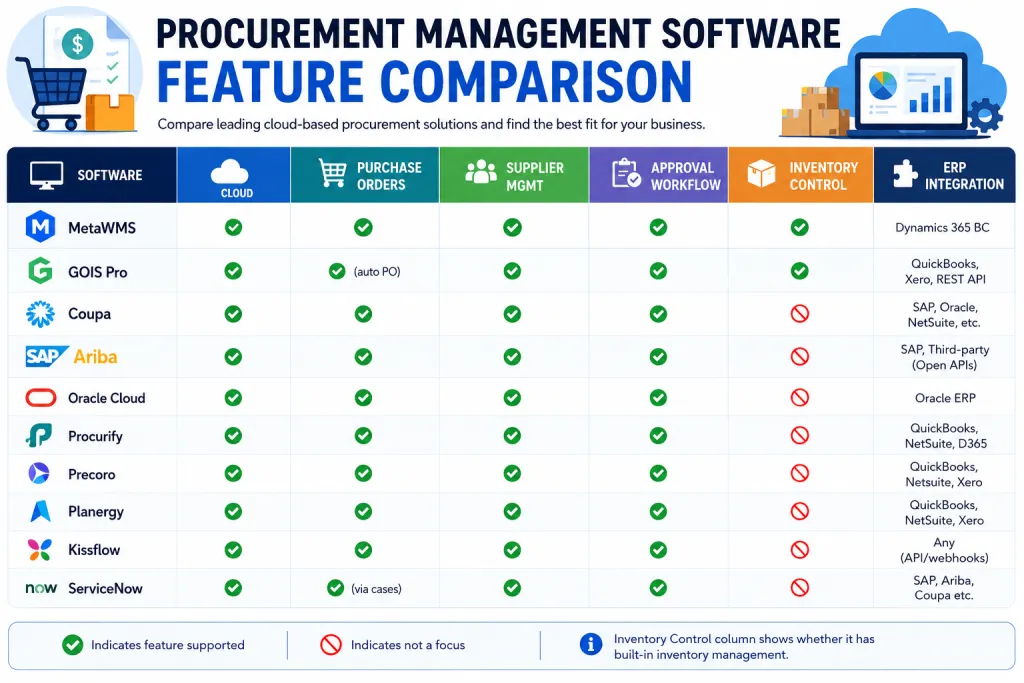
10 Top Procurement Software Platforms in 2026:
Here is the list of 10 top procurement software platforms ranked on the basis of key features, better value for me, AI integration, and support services:
1. MetaWMS — Best Overall Procurement/Warehouse Suite
Overview: MetaWMS is primarily a warehouse management system built on Dynamics 365 BC. It provides real-time inventory control, barcode scanning, and integrated order/PO workflows. The cloud-based WMS platform syncs with ERP and procurement, ensuring end-to-end visibility. We will emphasize MetaWMS’s procurement tie-ins: e.g., it triggers POs based on stock levels and updates purchase requests with live warehouse data.
Key Features: Inventory/warehousing (receiving, put-away, picking/packing), Barcode & QR code scanning for accuracy, PO creation/tracking (via reorder points), supplier/vendor management, and Dynamics 365 ERP integration. Its cloud deployment allows anytime access.
Pros: Integrated warehouse + procurement (all-in-one), real-time stock sync, strong Microsoft ERP integration, mobile scanning. Users praise ease of use and unified data flow (inventory and purchasing).
Cons: Being WMS-first, advanced procurement features may be simpler than specialized spend solutions. (We assume “Contact vendor” for pricing; likely per user or per transaction model.)
Best For: Businesses that need procurement tightly coupled with warehouse/inventory management (e.g. manufacturers, distributors).
2. GOIS Pro — Best for Inventory-Driven Procurement
Overview: GOIS (Goods Order Inventory System) is a cloud inventory and order management platform that includes procurement capabilities. It excels at automating purchase orders based on stock levels and managing multi-channel orders (Shopify, etc.). We’ll pitch it as “procurement for inventory-focused businesses.”
Key Features: Real-time inventory across warehouses, automatic PO generation (reorder points), vendor tracking, multi-channel order sync (Shopify, marketplaces), barcode verification on receiving (scan PO barcodes). Integrations include QuickBooks, shipping carriers, and REST API.
Pros: Very user-friendly interface (desktop/mobile), excellent support (per reviews). Effective at replacing QuickBooks advanced inventory. High G2/Capterra ratings for ease-of-use and customer service.
Cons: Reporting and analytics are basic; lacks some enterprise procurement features (e.g. complex contract mgmt). Some inventory features (e.g. open PO edits) have limitations.
Best For: Small-to-midsize distributors, retailers, or e-commerce companies needing tight inventory/procurement integration.
3. Coupa Procurement Cloud — Best Spend Management Platform
Overview: Coupa is a market-leading cloud Spend Management suite (Business Spend Management) headquartered in San Mateo, CA. Its procurement module offers full P2P and strategic sourcing capabilities. Coupa’s Procurement features include PO creation, supplier catalogs/punchouts, contract management, and policy-driven approval workflows. It also ties into Coupa’s broader suite (invoicing, T&E, expense, analytics).
Key Features: Guided buying with catalogs/punchouts, dynamic approval routing, budget controls, e-invoicing/PO matching, supplier collaboration and community features. It includes robust analytics dashboards for spend visibility (C-Suite dashboards of spend by category/department).
Pros: Enterprise-grade platform with AI-driven insights, high scalability. Strong user ratings for PO workflow speed and rich functionality (e.g. risk mgmt, supply optimization). Integrates with ERPs like SAP, Oracle, NetSuite, etc.
Cons: Complex setup with a steep learning curve for small teams. Premium pricing (contact vendor). Some users report customization/reporting can be rigid.
Best For: Large enterprises and mid-market companies in industries like healthcare, retail, finance, or education that need an all-in-one procurement/spend solution.
4. SAP Ariba — Best AI-Driven Source-to-Pay Suite
Overview: SAP Ariba (by SAP) is a comprehensive source-to-pay suite designed for global enterprises. The next-gen SAP Ariba (AI-native) supports procurement planning, sourcing, buying, invoicing, and supplier collaboration in one platform.
Key Features: AI-assisted intake (Joule agents), intelligent contract lifecycle mgmt, advanced sourcing optimization, supplier 360 profiles with risk scoring. It includes an integrated business network (SAP Business Network) for global trading partner exchange.
Pros: Highly configurable and powerful. Known for deep features like guided buying, dynamic discounts, fraud detection. Proven at scale (used by many Fortune 500s). Integrates well with SAP ERP.
Cons: Very costly and often requires heavy consulting and SAP-savvy teams. UI complexity can be challenging; better for SAP-centric organizations.
Best For: Large, complex organizations requiring robust compliance, global supplier management, and AI-driven sourcing—especially those already on SAP ERP.
5. Oracle Fusion Cloud Procurement — Best Large Enterprise Procurement
Overview: Oracle’s Fusion Cloud Procurement is part of Oracle Cloud ERP, offering source-to-settle capabilities. It automates processes from sourcing and contracting through purchasing and supplier management.
Key Features: Guided sourcing and negotiation (AI recommendations), contract authoring and compliance tools, automated procurement and receiving (PO creation, approval, matching), supplier portal, and sustainability reporting. The platform emphasizes AI and UX, with self-service purchasing and alerts for contract expiry.
Pros: Deep enterprise functionality. Strong analytics and AI features (e.g. AI-generated approval summaries). Part of the unified Oracle suite (ERP, SCM, HCM etc).
Cons: Best for Oracle-centric enterprises. Pricing/licensing is high (contact Oracle for quote). Implementation can be complex.
Best For: Large global enterprises, particularly those using Oracle Cloud ERP already.
6. Procurify — Best for Mid-Market Spend Control
Overview: Procurify (Toronto, Canada/US) is an AI-enhanced procurement platform focusing on ease-of-use and spend visibility. It covers “purchase requests to payment” with a strong mobile/web experience. Procurify is known for approval workflows and even integrated spend cards (with cashback rewards).
Key Features: Purchase request module, multi-stage approvals, PO issuance, receiving, invoice matching. Advanced features include virtual and physical spending cards, real-time budget tracking, and AI spend insights. Integrates with QuickBooks, NetSuite, Dynamics 365, etc.
Pros: Highly rated for user experience (G2 Top Performer, 4.6 stars). AI workflows automate routine tasks and help find cost savings. Good support.
Cons: May need more depth in accounting/budget features (some reviews note improvements desired). Per-seat pricing (contact vendor).
Best For: Growing mid-size companies that need modern approvals and spend controls but not an ultra-lean solution (often used in tech, manufacturing, biotech, etc).
7. Precoro — Best for Mid-Sized Decentralized Operations
Overview: Precoro is a procurement automation platform geared to mid-market companies with multiple units or locations. It offers a turnkey P2P suite with AI assistance for requisitions and approvals. Its selling point is fast implementation and out-of-the-box functionality.
Key Features: Requisition intake forms, PO creation/approval workflows, invoice matching (AP automation), and supplier management. It includes spend control (approved catalogs, budget limits) and integrates with accounting/ERP (NetSuite, QuickBooks, Xero). AI features include auto approval routing and invoice data extraction.
Pros: Very intuitive UI; reviewers say it’s “very intuitive” and fast to onboard. Good for enforcing policy and reducing maverick spend. Many positive customer case studies (7× faster month-end, 0% purchase error rates).
Cons: Some have noted limited customization in PO building; and integration setup can have hiccups. Pricing packages; contact vendor for details.
Best For: Mid-sized, distributed enterprises (e.g. multi-branch logistics, franchise networks) that need standardized procurement processes without heavy IT involvement.
8. Planergy (formerly PurchaseControl) — Best for Finance Teams & SMBs
Overview: Planergy (US-based) is a cloud Procure-to-Pay platform for small-to-midsize organizations. Key capabilities include requisitions, budget tracking, PO management, AP automation, and vendor onboarding. It’s known for strong budgeting and reporting.
Key Features: Purchase requisition/approval system, PO creation and tracking, goods receipt matching, invoice processing (AP), and robust budgeting (enforce budgets during approvals). It offers real-time spend dashboards, AP visibility, and an audit trail for compliance. Integrates with QuickBooks, NetSuite, Xero, etc.
Pros: Cloud-based and user-friendly, with flexible approval workflows (customizable by department, amount, etc.). Customers highlight rapid ROI via faster PO approvals and better budget control.
Cons: Not designed for inventory management or extremely high-volume procurement. Some users note limited advanced analytics or handling of returns/credit memos.
Best For: Finance/operations teams in SMBs and mid-market (e.g. construction, logistics, nonprofits) that need tighter spend oversight and AP integration, especially with QuickBooks/Netsuite.
9. Kissflow Procurement Cloud — Best for Customizable PO Workflows
Overview: Kissflow (USA/India) offers a no-code platform where users can build custom procurement workflows. The Kissflow Procurement Cloud covers purchase requests, POs, vendor management, and invoice approvals in one place. It’s strong on ease-of-setup and flexibility.
Key Features: Drag-and-drop workflow builder for requisitions→PO→approval. Role-based access controls, auto PO generation, invoice matching, and vendor catalogs. Since it’s highly customizable, businesses tailor forms, fields, and rules without coding.
Pros: Very easy for SMBs to implement quickly. Reduces manual PO tasks and errors. Provides transparent status of all POs (tracking and reporting). Reasonably priced with free trials/demos.
Cons: Lacks some advanced sourcing or analytics features of enterprise tools. More basic UX than specialized procurement suites.
Best For: Small businesses and departments that need a lightweight, configurable procurement system without IT overhead, especially where flexibility is key.
10. ServiceNow Procurement Service Management — Best Enterprise Workflow Automation
Overview: ServiceNow (Santa Clara, CA) recently expanded into procurement with its Procurement Service Management offering. This is part of the Now Platform, targeting large enterprises seeking to centralize and automate procurement tasks across teams.
Key Features: Centralized request intake and case management, automated workflows, and tight integration with IT/HR flows. It provides guided self-service portals for suppliers and employees, and analytics on SLA compliance. It integrates with major source-to-pay systems (Ariba, Coupa, SAP, homegrown) via ServiceNow’s Integration Hub.
Pros: Excellent for companies already using ServiceNow ITSM/ERP — procurement can be managed alongside IT and HR requests. Strong workflow automation reduces manual tasks.
Cons: Not standalone (requires ServiceNow platform). Better suited for indirect procurement processes (service requests, invoice inquiries) rather than heavy P2P.
Best For: Large organizations with decentralized procurement needing a single platform for all service requests, especially those already committed to ServiceNow for ITIL/ERP.
Frequently Asked Questions (FAQs)
Here are some commonly asked questions from readers looking for the best procurement management software:
What is procurement management software?
Procurement management software is a digital solution that helps businesses manage the complete purchasing process, including purchase requests, supplier management, purchase orders, approvals, receiving goods, invoice matching, and reporting. It reduces manual work while improving accuracy and visibility.
What is the difference between procurement and purchasing?
Purchasing is only one part of procurement. Purchasing focuses on buying goods and services, while procurement includes supplier selection, negotiations, contract management, approvals, purchasing, receiving, and supplier performance evaluation.
Which procurement management software is best for small businesses?
Small businesses should look for software that is affordable, easy to implement, and scalable. Solutions like MetaWMS, Precoro, Procurify, and Kissflow Procurement are popular choices because they offer automation without the complexity of enterprise-level systems.
Can procurement software integrate with ERP systems?
Yes. Most modern procurement platforms integrate with ERP solutions such as Microsoft Dynamics 365 Business Central, SAP, Oracle, NetSuite, QuickBooks, and other accounting and inventory management systems. This eliminates duplicate data entry and improves operational efficiency.
Is cloud-based procurement software better than on-premise software?
For most businesses, yes. Cloud-based procurement software offers lower upfront costs, automatic updates, remote accessibility, better scalability, stronger collaboration, and faster implementation compared to traditional on-premise systems.
Does procurement software help reduce business costs?
Yes. Procurement software helps businesses reduce costs by automating repetitive tasks, preventing duplicate purchases, improving supplier negotiations, minimizing manual errors, increasing approval efficiency, and providing better visibility into company spending.
Can procurement software improve supplier relationships?
Absolutely. Most procurement platforms include supplier portals, performance tracking, communication tools, and centralized vendor records that help businesses collaborate more effectively with suppliers and build stronger long-term partnerships.
How much does procurement management software cost?
Pricing varies depending on the vendor, deployment model, number of users, and available features. Small business solutions often start with affordable monthly subscriptions, while enterprise platforms typically offer custom pricing based on business requirements.