



When it comes to choosing the Best 3PL Warehouse Management Software in 2026, go beyond just evaluating the inventory tracking feature. The modern 3PL Warehouse management software solutions are all about offering real-time visibility, automation, AI-driven data-based decision making, and improving multi-channel fulfilment efficiency for 3PL companies.
With the increasing complexity of eCommerce orders, omnichannel retail, global supply chain volatility, and customer expectations for same-day deliveries, traditional 3PL warehouse systems have become outdated and no longer enough.
If you’re still managing inventory, order fulfilment, labor planning, and reporting across disconnected systems and using spreadsheets, then you are surely overlooking the blind spots in the form of cost, efforts, and customer trust.
However, when you are landed in the market, how will you pick the best Warehouse Inventory tracking software? Let’s explore the best 3PL warehouse management software shaping warehouse efficiency in 2026.
11 Best 3PL Warehouse Management Software in 2026 To Watch Out
While looking forward to implementing the 3PL Warehouse Management Software, the real question is not to ask which WMS is popular, but which WMS aligns with your operational complexity, ERP ecosystem, automation maturity, and growth stage. Below is a strategic list of best 3PL warehouse management software solution that can help overcome 3PL Warehouse Inventory Management challenges in 2026:
1. GOIS Warehouse Management Software
GOIS is a next-generation cloud-based inventory and warehouse management system designed to streamline complex 3PL operations. It enables logistics providers to manage multi-client inventory, orders, and warehouse workflows in real time while ensuring complete visibility and control across locations. With its centralized platform, GOIS bridges the gap between inventory tracking, order processing, and warehouse execution for highly efficient 3PL management.
Core Capabilities
- Real-time inventory tracking across multiple clients and warehouses
- Multi-location warehouse management with centralized control
- Order management with seamless picking, packing, and dispatch tracking
- Batch, lot, and serial number tracking for full traceability
- Automated stock updates to reduce manual errors and discrepancies
- Real-time reporting and dashboards for operational visibility
Pros
- Cloud-based system with access from anywhere
- Ideal for managing multi-client (3PL) inventory efficiently
- Scalable solution for growing warehouse operations
- Improves accuracy and reduces stock mismatches
- Easy-to-use interface with minimal learning curve
Cons
- Advanced integrations may require initial setup support
Best For: 3PL providers, logistics companies, distributors, and businesses managing multi-client warehouse operations who need real-time visibility, accuracy, and scalable inventory control.
2. MetaWMS Warehouse Management Software
MetaWMS is a deeply integrated 3PL warehouse inventory management software built specifically for businesses running Microsoft Dynamics 365 Business Central and NAV. It bridges operational gaps between ERP and warehouse execution with seamless integration with other systems to ensure businesses work with fully connected systems.
Core Capabilities
- Offering real-time inventory tracking with barcode/RFID
- Automated picking, packing & shipping
- Multi-location warehouse control
- Lot & serial tracking with full audit trails
- Native Dynamics BC/NAV integration
- Cycle & annual inventory counting
Pros
- Microsoft Dynamics certified
- Customizable workflows and seamless integration
- Mobile access & automation-ready
- No technical training is required
Cons
- Advanced customization requires expert setup
Best For: Distributors, manufacturers, and Microsoft Dynamics ecosystems seeking seamless ERP-to-warehouse synchronization.
3. Extensiv 3PL Warehouse Inventory Management
Extensiv is a cloud-native platform designed for multi-channel retail and 3PL environments where speed and flexibility are critical.
Core Capabilities
- Cloud-based WMS access
- Automated order routing across warehouses
- Real-time stock alerts
- Integrations with Shopify, Amazon, BigCommerce, QuickBooks
- Demand forecasting analytics
Pros
- Strong multi-channel integrations
- Intuitive interface
- Centralized analytics
Cons
- Limited deep reporting customization
- May feel feature-heavy for smaller teams
Best For: Omnichannel brands, 3PLs, and multi-warehouse operations.
4. Manhattan Active WMS
Manhattan is a globally recognized one of the best 3PL Warehouse management software that businesses can refer to in 2026. It is intelligently crafted to handle high-volume distribution environments as it excels in robotics and AI-enabled orchestration.
Core Capabilities
- AI-driven task interleaving
- Robotics orchestration
- Real-time fulfillment visibility
- Workforce optimization
- Yard & dock management
Pros
- Ensuring enterprise-grade scalability
- Robotics-ready architecture
- Advanced AI-driven inventory optimization
Cons
- Expensive upfront cost of implementation
- Due to high complexity of system, it required team training
Best For: Global distribution centers and automation-heavy enterprises.
5. Oracle Warehouse Management Cloud
Oracle is an enterprise-grade cloud-based 3PL WMS software that supports multi-location warehouse operations with digital twin modelling and integrated financial planning.
Core Capabilities
- End-to-end supply chain optimization
- Digital twin warehouse modeling
- Global inventory visibility
- Dock, yard & labor management
Pros
- Offering cloud scalability with business expansion
- Strong automation ecosystem
Cons
- Premium pricing which is bit expensive for small businesses
- Complex for smaller teams
Best For: Large global enterprises with complex supply networks.
6. SAP Extended Warehouse Management
Positioning: Deep SAP-native warehouse control
SAP is an extended 3PL Warehouse Management Software that delivers high-level control for enterprises that are already embedded in SAP’s ecosystem.
Core Capabilities
- Instead of manual tracking, it offer RFID stock tracking
- Seamless wave & slotting management
- Resource optimization for better efficiency
- Automated inbound/outbound workflow
- SAP S/4HANA integration
Pros
- Offering industry-leading automation
- Strong large-scale supply chain performance
Cons
- Expensive & time-consuming deployment
- Best suited for users who are already using SAP
Best For: Enterprises running SAP-driven workflows and ready to upgrade their Warehouse Inventory tracking system.
7. Infor CloudSuite WMS
Positioning: Visualization-driven smart warehouse execution
CloudSuite WMS combines automation with 3D visualization, which allows teams to detect warehouse bottlenecks faster and be able to make informed decisions.
Core Capabilities
- 3D warehouse visualization
- Voice-enabled picking
- Multi-site visibility with the Infor WMS System
- Workflow automation for better efficiency
Pros
- Strong visualization tools
- Automation-ready infrastructure
Cons
- Requires onboarding and team training
Best For: High-volume warehouses seeking planning visibility.
8. Blue Yonder Warehouse Inventory Management
Positioning: AI-powered predictive 3PL Warehouse Inventory Management
Blue Yonder is a modern 3PL Warehouse Management Software that heavily focuses on AI-powered predictive analysis and labor optimization.
Core Capabilities
- AI demand forecasting and cut down guessworks
- Real-time data update and visibility
- Multi-site centralized tracking
- Automated labor allocation
Pros
- Advanced predictive analytics
- Holistic supply chain view
Cons
- High upfront investment
Best For: Retailers, eCommerce leaders, and global distribution hubs.
9. Microsoft Dynamics 365 Supply Chain Management
Positioning: Enterprise-wide supply chain intelligence platform
Microsoft Dynamics 365 supply chain management is not a dedicated 3PL WMS software, but it works more like a WMS by providing a full-scale AI-driven supply chain platform.
Core Capabilities
- Advanced wave & zone picking
- AI demand forecasting
- IoT-enabled inventory tracking
- Integrated procurement & manufacturing
- Azure & Power BI integration
Pros
- Offering enterprises to scale easily without any hiccups
- Deep analytical dashboard and automation
- Unified Microsoft ecosystem
Cons
- Complex implementation makes it time-consuming
- Higher upfront cost makes it expensive to install
Best For: Large enterprises engaged in managing global supply chains.
10. Softeon Warehouse Management Software
Positioning: Wave-less fulfillment & orchestration specialist
Softeon supports high-speed fulfillment with distributed order management. This could be one of the best 3PL Warehouse Management Software that offers waveless processing of the warehouse.
Core Capabilities
- Distributed order management
- Robotics support
- Multi-client 3PL support
Pros
- Highly configurable and customizable solution
- Offering a unique combination of strong OMS and WMS synergy
Cons
- UI modernization needed
Best For: Complex 3PL and multi-client warehouses.
11. NetSuite Warehouse Inventory Management
Positioning: Unified ERP + WMS for mid-sized businesses
NetSuite WMS simplifies 3PL warehouse operations within a cloud ERP ecosystem. It offers a unified ERP and WMS platforms and allows mid-sized businesses to have a broad view of 3PL warehouse workflow.
Core Capabilities
- RFID barcode scanning
- Real-time picking & put away
- Lot/serial tracking
- Multi-location visibility
- Native NetSuite ERP integration
Pros
- Seamless ERP connectivity
- Fast cloud deployment
Cons
- Limited advanced automation
Best For: Mid-sized businesses seeking a combination of ERP and WMS unification.
This is a list of the best 3PL warehouse management software solutions that you can consider to simplify your warehouse operations or if planning to upgrade from NAV to BC. But in case, if you are still confused about which is the best fit to your business needs, then go through this quick comparison.
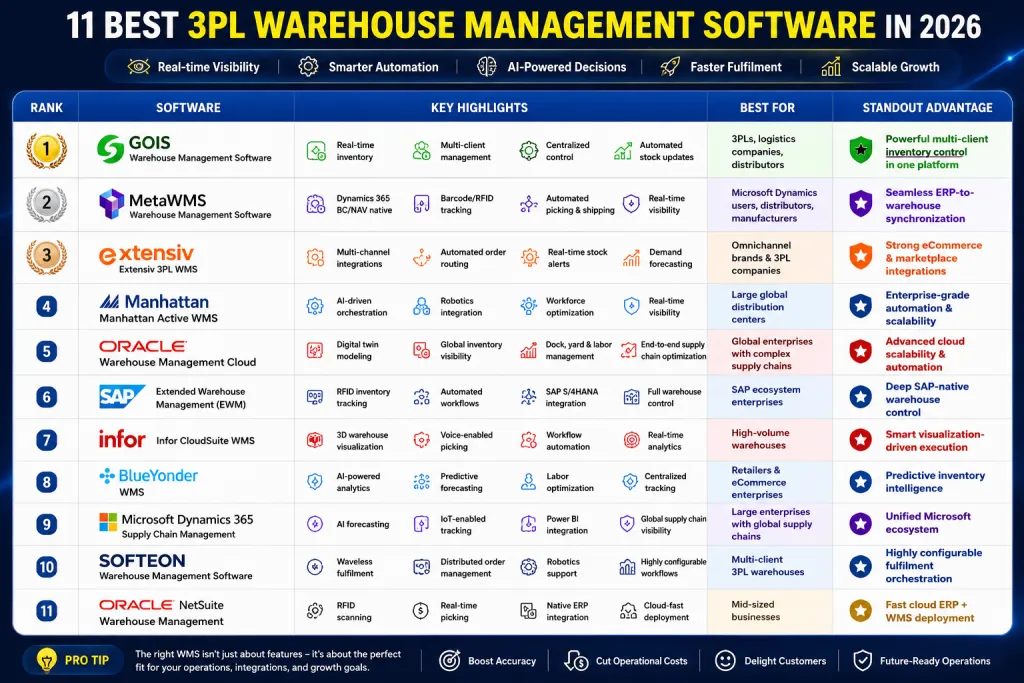
Strategic Insight: How to Choose the Best 3PL WMS in 2026?
With a plethora of WMS systems available to choose from, finding the best-fitted WMS solution is quite challenging. But while looking for the best 3PL Warehouse Management Software, keep in mind that it is not about choosing the most expensive or feature-heavy one.
It’s the one that aligns with:
- Your existing ERP ecosystem
- Warehouse volume complexity
- Automated workflow
- Multi-location scalability
- AI-readiness goals
- Budget & implementation capacity
In 2026, warehouse success is defined by real-time intelligence, automation orchestration, and ecosystem integration, not just inventory accuracy.
Final Words
This blog has compiled the list of best 3PL Warehouse Management Software in 2026, but the ultimate choice depends upon your business needs. What solutions work best for you may not fit others, as different warehouses have different needs.
Therefore, we tried to list the best performing 3PL Warehouse Management Software in this blog without getting biased. Businesses can quickly shortlist the WMS system that delivers real-time visibility, automated workflows, and seamless integration with ERP and supply chain platforms.
The solutions discussed above have their own strengths and limitations which you need to evaluate with your needs. From enterprise automation platforms like Manhattan Active WMS and Oracle 3PL Warehouse Inventory Management Cloud, to ERP-native systems like MetaWMS 3PL Warehouse Management Software and NetSuite 3PL Warehouse Inventory Management, the right choice depends on your warehouse scale, ERP ecosystem, automation needs, and long-term growth strategy.
Common FAQs Related to 3PL Warehouse Management Software
What is a 3PL Warehouse Management Software (WMS)?
A 3PL Warehouse Management Software (WMS) is a specialized system designed to help third-party logistics (3PL) providers manage and optimize warehouse operations for multiple clients from a single platform.
In simple terms:
It’s a software that allows logistics companies to store, track, manage, and fulfill inventory on behalf of different businesses, while keeping each client’s data separate and organized.
2. What are the top benefits of using a WMS?
The top benefits of using a modern WMS system include real-time inventory visibility, faster picking, packing, and shipping, minimizing manual errors, optimizing warehouse space utilization, or even improving demand forecasting.
3. Which industries commonly use 3PL Warehouse Management Software?
3PL Warehouse Management Software is commonly used across industries that rely on efficient inventory handling and outsourced logistics, including eCommerce and retail, which depend on fast order fulfillment and omnichannel operations; FMCG, where high inventory turnover and expiry tracking are critical; pharmaceuticals and healthcare, which require strict compliance, lot tracking, and temperature-sensitive storage; manufacturing, for managing raw materials and finished goods with just-in-time workflows; automotive, where thousands of parts must be accurately tracked and distributed; and electronics and high-tech, which need precise inventory control and secure handling of high-value products- making 3PL WMS essential for any sector dealing with complex, high-volume, and multi-client supply chains.
4. How does a WMS integrate with ERP systems?
Many WMS platforms integrate directly with ERP systems such as SAP S/4HANA, Oracle ERP Cloud, and Microsoft Dynamics 365 Supply Chain Management to synchronize inventory data, orders, procurement, and financial information across the organization.
5. What features should businesses look for in a WMS in 2026?
Important features include:
1. Real-time inventory tracking
2. Barcode or RFID scanning
3. Multi-3PL Warehouse Inventory Management
4. Automated picking and replenishment
5. Integration with ERP and eCommerce platforms
6. Analytics and reporting dashboards